
Canadian Mortgage Arrears Hit a 12-Year High: What the May 2026 Numbers Mean in BC
Canadian Mortgage Arrears Hit a 12-Year High: What the May 2026 Numbers Mean in BC
The Canadian Bankers Association counted 14,061 residential mortgages in arrears at the end of May 2026, up 27.2% from May 2025 and the highest count since March 2014. That's the scary version. The full version is that 14,061 is 0.29% of 4,925,389 mortgages, so 99.71% of bank mortgage holders are paying on time, and British Columbia sits at 0.26%, below the national rate and the second lowest region in the country.
Every figure on this page comes from the Canadian Bankers Association's Number of Residential Mortgages in Arrears table for the month ended May 31, 2026, the most recent release available on 2026-08-20. The CBA counts a mortgage as in arrears when it's 3 or more months behind, and its data covers the big 6 banks plus Manulife Bank, Laurentian Bank and Equitable Bank. Yukon is folded into the British Columbia figure. The 99.71% and the 27.2% are calculated from the CBA's own counts.
What the Headline Number Actually Says
A mortgage in arrears means a payment is 3 or more months overdue. It isn't a foreclosure. In BC the equivalent of a foreclosure is a court-ordered sale, and arrears are what happens well before that stage. Arrears are also a lagging indicator: a borrower who falls behind in May was under financial stress months earlier.
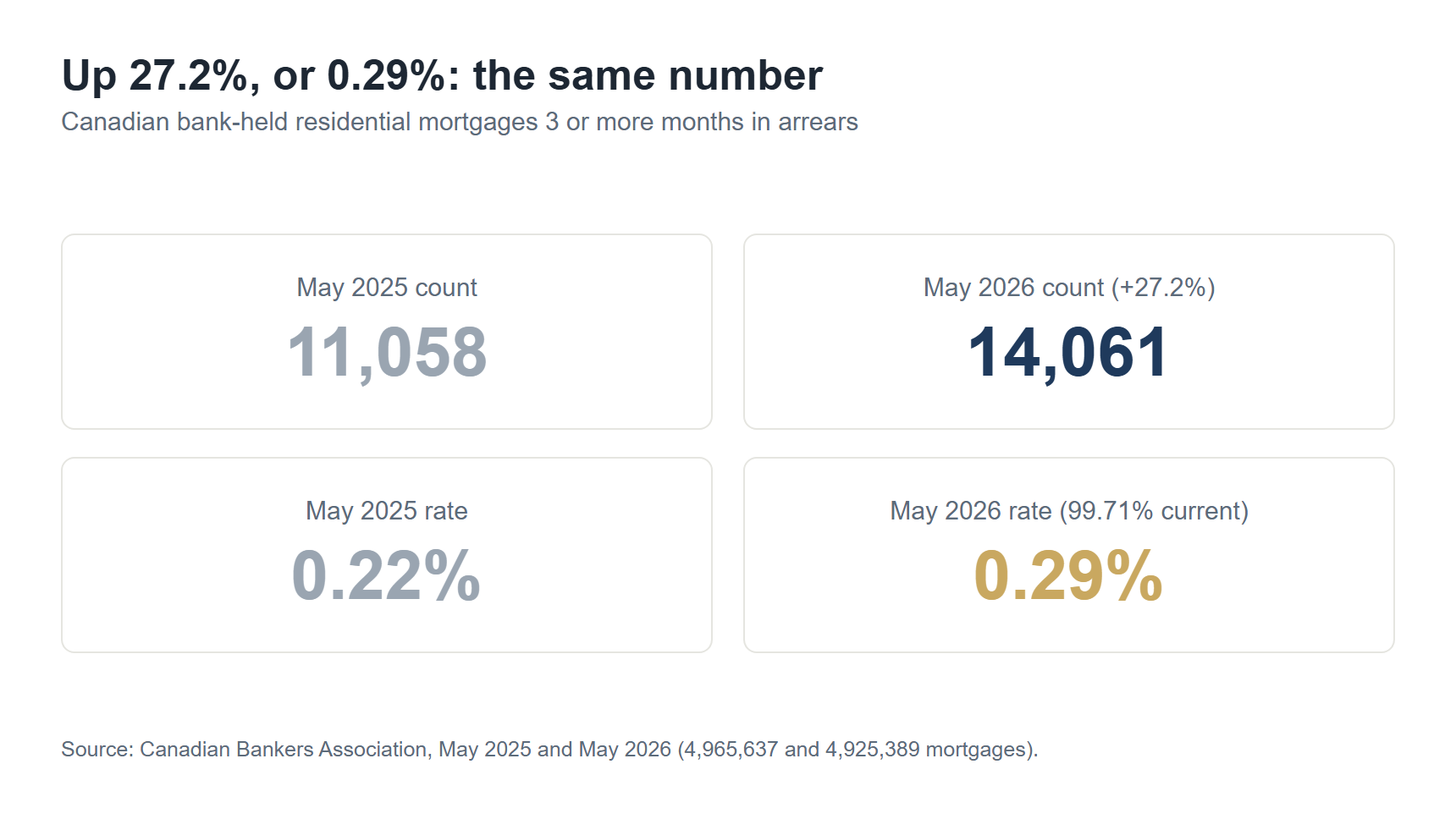
In May 2026 the CBA counted 14,061 mortgages in arrears out of 4,925,389 residential mortgages held by its reporting banks, a rate of 0.29% (CBA, May 2026). A year earlier, in May 2025, it was 11,058 of 4,965,637, or 0.22%. The count is up 27.2% year over year, and it's the highest count in the series since March 2014, when it was 14,093. The rate is the highest since August 2016, when it also sat at 0.29%.
That's a real move and it's worth saying so plainly. It's also 0.29%. Canada's arrears rate peaked at 0.45% in January 2010 after the 2008 financial crisis, and through the mid-1990s it ran between 0.50% and 0.65% (CBA historical series). The current rate is roughly double the 0.14% record low from mid-2022, and still well under where the country sat during either of those periods.
Where British Columbia Sits
BC had 1,794 mortgages in arrears out of 689,327 in May 2026, a rate of 0.26% (CBA, May 2026). In May 2025 it was 1,385 of 696,213, or 0.20%. So BC's count is up 29.5% year over year, slightly faster than the national pace, but from a lower starting point, and the province is still under the national 0.29%. Here's how every region in the CBA table compares for May 2026:
| Region | Mortgages | In Arrears | Arrears Rate | Rate in May 2025 |
|---|---|---|---|---|
| Saskatchewan | 119,973 | 571 | 0.48% | 0.53% |
| Manitoba | 114,576 | 397 | 0.35% | 0.33% |
| Ontario | 2,151,253 | 6,953 | 0.32% | 0.21% |
| Atlantic Canada | 335,441 | 1,041 | 0.31% | 0.27% |
| Canada | 4,925,389 | 14,061 | 0.29% | 0.22% |
| Alberta | 570,601 | 1,519 | 0.27% | 0.26% |
| British Columbia | 689,327 | 1,794 | 0.26% | 0.20% |
| Quebec | 933,667 | 1,786 | 0.19% | 0.18% |
Source: Canadian Bankers Association, Number of Residential Mortgages in Arrears, month ended May 31, 2026. Territories are excluded because the CBA suppresses their arrears counts. Alberta's figure includes the Northwest Territories and Nunavut.
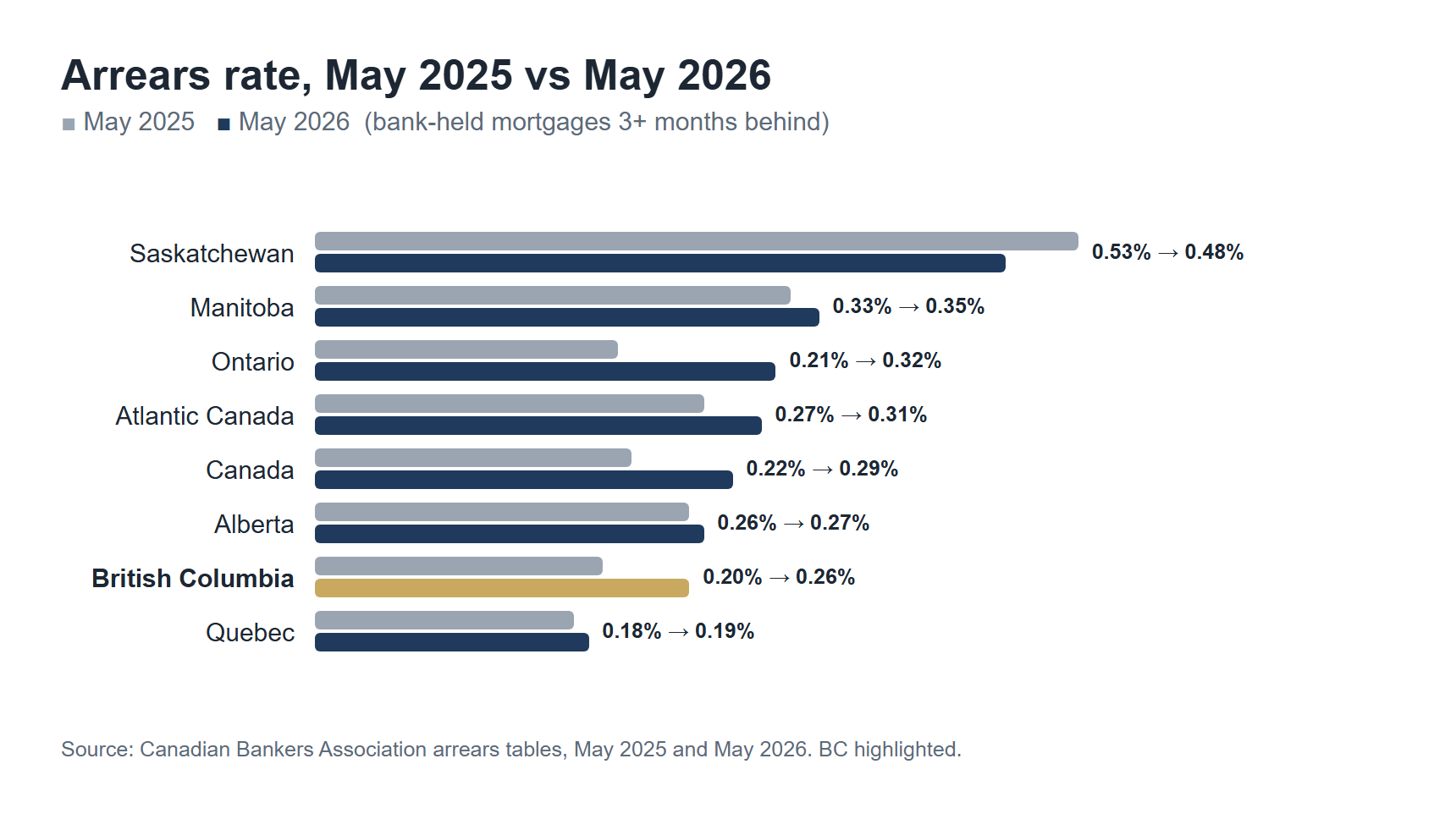
Two things stand out in that table. Ontario is where the year-over-year move is concentrated: its rate went from 0.21% to 0.32%, and its 6,953 arrears are just under half the national total. And the Prairies, with the highest rates, have the smallest mortgage pools, so they move the national number very little. A Canadian headline about arrears is mostly an Ontario story, with Saskatchewan and Manitoba setting the ceiling.
BC is neither. It's the second lowest region in the table and below the national rate, the same position it held in the 2025 data. For context on how low BC can go, the province sat at 0.10% through most of 2022 (CBA, May to November 2022), so 0.26% is a real climb off that floor, and it's also nowhere near the 0.45% BC recorded in August and September 2010.
Why the Rate Is Climbing
Part of it is arithmetic. The total number of mortgages held by CBA banks fell from 4,965,637 in May 2025 to 4,925,389 in May 2026, a drop of 40,248 (CBA, May 2026). When the denominator shrinks while the arrears count grows, the rate rises faster than the count alone would suggest. That isn't a reason to dismiss the number, but it's a reason not to read 0.22% to 0.29% as purely new borrowers falling behind.
The bigger driver is the labour market. The Bank of Canada's staff analytical paper on the drivers of mortgage arrears, published in March 2026, estimates that a 1 percentage point rise in the unemployment rate pushes the arrears rate up by about 0.1 percentage points roughly a year later. That lag is why arrears are a rear-view mirror. The May 2026 number is telling you about household stress that started building in 2025, and whatever the unemployment rate does this summer shows up in the arrears table in 2027.
The CBA's own framing in its release commentary is that more than 99% of bank mortgage holders remain in good standing, and that further increases are possible if the labour market weakens. Both halves of that sentence are true at the same time, which is the whole point of reading the table instead of the headline.
What This Means If You're Buying in the Fraser Valley
If you've been waiting for a wave of distressed sales to reset prices, the May 2026 data doesn't support that plan. BC's 1,794 arrears are spread across a province of 689,327 bank mortgages, and only a fraction of arrears ever become court-ordered sales. The Fraser Valley already has more inventory than buyers are absorbing for ordinary reasons, and that's doing far more to shape prices than distress is. The data on Fraser Valley foreclosures walks through what the court-ordered sale pipeline locally actually looks like.
The more useful takeaway is about your own numbers. Arrears track unemployment with a year's lag, so the question to ask before you buy isn't "will the market crash" but "what happens to this payment if my household income drops for 6 months". A buyer who can answer that comfortably is in a different position from one who's stretching, regardless of what the national rate does next.
Thinking About Buying or Selling in the Fraser Valley?
The best first step is a quick conversation. Pick a time in the calendar that works for you and we'll talk it through.
What This Means If You Own a Home
If you're current on your mortgage, the May 2026 table changes nothing about your position. What it does change is how you should read the next round of headlines. The count will very likely keep rising for a while, because the labour-market stress the Bank of Canada links to arrears has already happened and is still working through the lag. A higher number in the June or July 2026 release isn't news about a new problem, it's the same problem arriving on schedule.
If you're behind or expect to be, the thing to do is talk to your lender before you miss a third payment, because the CBA's 3-month definition is also roughly the point where options narrow. Lenders generally have more flexibility early, and the existence of 14,061 arrears in a pool of 4.9 million is a reminder that you're not in an unusual situation, you're in a small and well-trodden one.
Common Mistakes to Avoid
Confusing Arrears With Foreclosures: Arrears mean a borrower is 3 or more months behind. A court-ordered sale in BC is a separate, slower legal process, and most arrears are resolved before it starts.
Reading the Change Instead of the Rate: Up 27.2% sounds like a crisis. 0.29% doesn't. They're the same number.
Applying the National Figure to Your Street: Saskatchewan at 0.48% and Quebec at 0.19% are in the same table. BC at 0.26% is closer to Quebec than to the Prairies, and Surrey or Langley is a smaller market still.
Treating Canada Like the US in 2008: Canadian mortgages are full recourse in most provinces, including BC, so walking away from an underwater home isn't the straightforward option it was in parts of the US. That structural difference is part of why Canada's rate peaked at 0.45% in 2010 rather than several times that.
Ignoring It Entirely: The direction is up, the labour market is the reason, and both are worth watching. Calm isn't the same as indifferent.
What to Watch Next
The CBA publishes the arrears table monthly, a few months after the month it covers, so the June 2026 figure is the next one due. Watch 3 things. Whether the national count clears 14,093, the March 2014 figure it's now sitting just under. Whether BC's rate holds under the national rate, which it has through every month shown in the 2026 data. And the unemployment rate, because per the Bank of Canada's March 2026 analysis it's the number that tells you where arrears will be 12 months from now.
If you want the price side of the same story, the mortgage renewal math is the piece that explains where the payment pressure behind these numbers comes from.
Frequently Asked Questions
What does mortgage in arrears mean in Canada?
The Canadian Bankers Association counts a mortgage as in arrears when payments are 3 or more months overdue. It's a stage that comes well before a court-ordered sale, which is BC's equivalent of a foreclosure, and most arrears are resolved before reaching it.
How many Canadian mortgages are in arrears right now?
14,061 out of 4,925,389 bank-held residential mortgages as of May 2026, a rate of 0.29%, according to the Canadian Bankers Association. That's up from 11,058 and 0.22% in May 2025, and the highest count since March 2014.
What is the mortgage arrears rate in British Columbia?
0.26% in May 2026, or 1,794 mortgages out of 689,327, per the CBA. That's up from 0.20% in May 2025 but still below the national 0.29%, and the second lowest rate of any region in the CBA table after Quebec at 0.19%.
Is Canada heading for a foreclosure crisis?
The May 2026 data doesn't point that way. At 0.29%, the national arrears rate is below its January 2010 peak of 0.45% and far below the 0.50% to 0.65% range of the mid-1990s. The rate is rising, and the Bank of Canada links that to unemployment with about a 1-year lag, so it bears watching rather than panicking over.
Which provinces have the highest mortgage arrears?
In May 2026, Saskatchewan led at 0.48%, followed by Manitoba at 0.35%, Ontario at 0.32% and Atlantic Canada at 0.31%. Alberta was 0.27%, British Columbia 0.26% and Quebec 0.19%. Ontario's 6,953 arrears are nearly half the national count.
Why are mortgage arrears rising in Canada?
Mainly the labour market. The Bank of Canada's March 2026 staff analysis estimates a 1 percentage point rise in unemployment lifts the arrears rate by about 0.1 percentage points roughly a year later. A shrinking pool of bank mortgages, down 40,248 between May 2025 and May 2026, also pushes the rate up mechanically.
Related Reading
- Fraser Valley Foreclosures: What the Data Actually Shows
- Canada's Mortgage Renewal Crisis: The Math Banks Don't Show You
- Fraser Valley Housing Market Update: April 2026
- Detached Homes in Surrey Are Quietly Losing Value
- What Happens to Real Estate When the Dollar Collapses
- Surrey Neighbourhoods Ranked: A Local's Guide to Every Major Community

Alex Dunbar Personal Real Estate Corporation
REAL Broker BC Ltd. | Living in the Lower Mainland
Buying, selling or investing in the Lower Mainland? Whether you're new to the area or a longtime local, I'll help you make the right move. Book a 30-minute no-pressure call with me and we'll go over your goals, timeline and budget.
Categories
Recent Posts






GET MORE INFORMATION