
How to Read Strata Documents Before Buying a Condo or Townhome in BC
Watch the full video above, or read the 2026 written version below.
In This Guide
How To Actually Read What You're Given
At a Glance
The 6 Strata Documents Every Buyer Should Review
Always request these with your subject-to-document-review clause, never after subject removal. A 7th document, the Engineering Report, is a bonus when it exists: see the Depreciation Report section below.
Why Reading Strata Documents Matters
When you buy a condo or townhome in BC, you're not just buying the unit. You're buying a proportional share of the building, the land, and the strata corporation that manages both. That means you inherit every repair the building needs, every pending special levy, every contested council vote, and every deductible on the insurance policy.
BC-WIDE BENCHMARK
BC strata owners have paid an average of $19,676 in special levies over a recent 10-year window, and industry reviewers report that 90%+ of strata packages arrive incomplete, missing at least one required document. Reading the documents properly is the cheapest risk management you can buy.
The strata documents are the buyer's due-diligence window into all of that. Skipping them, or only reading the Form B, is the single most expensive mistake I see first-time condo buyers make. A clean-looking Form B can mask a building with a $40,000 special levy pending, a contested envelope remediation in the Minutes, or an insurance deductible above $100,000.
The seven documents below are what you need to review during your subject-to-document-review clause, before you waive subjects. Read them in order. If something in document 1 raises a flag, document 2 through 7 should either explain it or amplify it.
The 6 Strata Documents You Need to Read
Review them in this order. The order matters: each document either explains or contradicts the last, and reading them out of sequence makes the full story harder to see. An Engineering Report, if the strata has one, is a bonus 7th document. It's treated as a callout under the Depreciation Report below because the two overlap in what they describe.
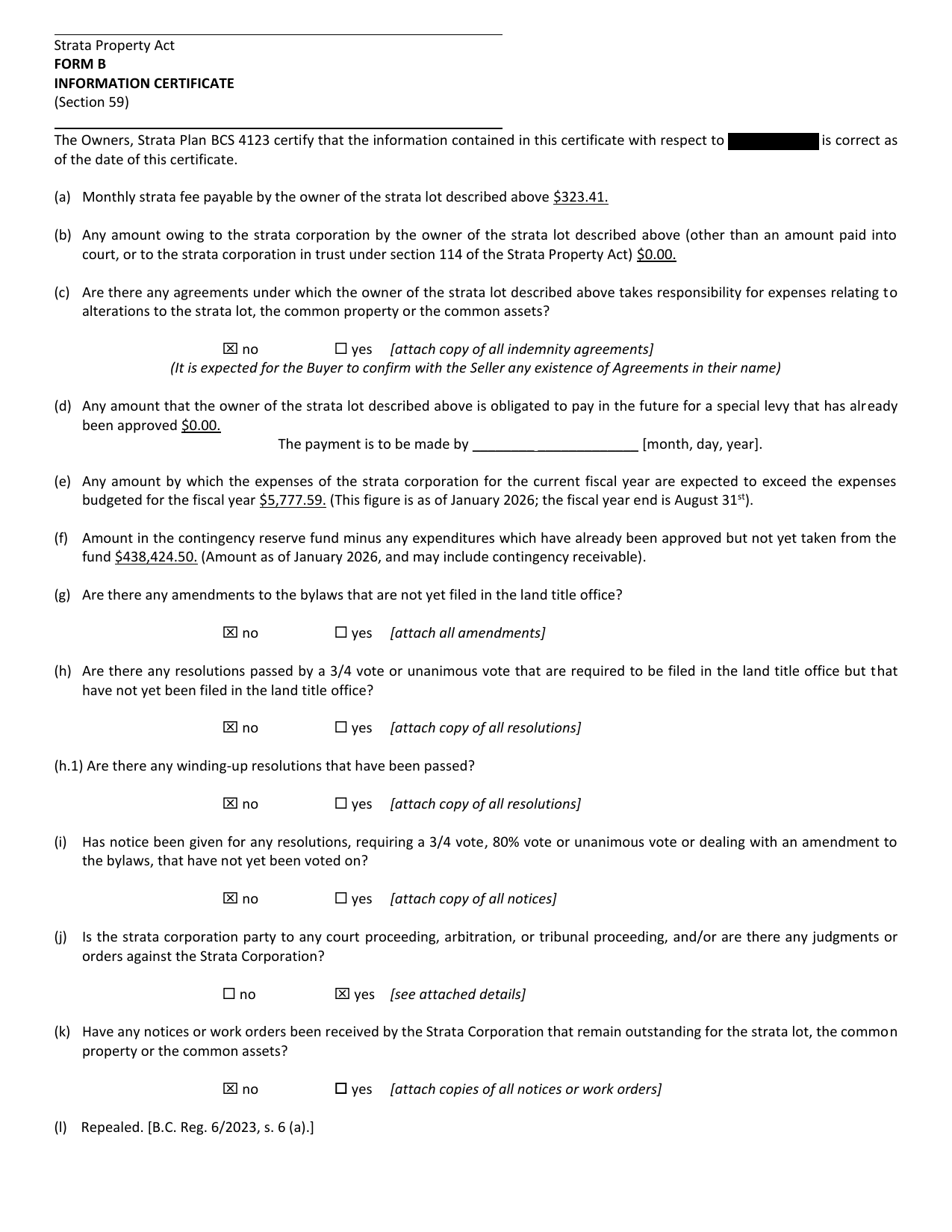
1. Form B (Information Certificate)
A snapshot of the strata corporation's current finances, bylaws, rules, insurance, and any ongoing issues. Legally required to be provided with any sale. Under the 2023 Strata Property Regulation update, the rental count field was removed, and an electrical planning report (if one exists) is now a mandatory attachment.
What to look for: Monthly strata fees, special levies in progress or recently paid, any pending litigation, a summary of funds held in the Contingency Reserve Fund (CRF), and the form date itself. The Form B should be dated within the last 30 to 60 days. Parking stall and locker designations should match the registered strata plan at the Land Title Office.
Red flags: Form B older than 60 days; upcoming special levies with no start date; litigation disclosed against the strata; CRF balance under $10,000 for a building over 40 units; parking/locker designations that conflict with the registered strata plan.
2. Bylaws & Rules
The rulebook. Bylaws are passed by strata owners with a 3/4 vote; rules are passed by the strata council. Together they govern everything from pets to renovations to short-term rentals. Two recent BC changes matter here: as of November 2022, strata corporations can no longer restrict long-term rentals (short-term/Airbnb restrictions still stand), and the May 2023 Strata Property Act update removed most age-based restrictions except for genuine 55+ communities.
What to look for: Pet restrictions (number, weight, breed), parking assignment rules, renovation pre-approval requirements, and Airbnb/short-term-rental bans. Any rental-restriction or "no one under 19" bylaw you see should be treated as historical, not binding, unless the 55+ designation is explicitly documented.
Red flags: Bylaws last updated before 2014 (likely missing modern sections); vague renovation rules; bylaws that read as if they've been copy-pasted from another complex; restrictions that were unenforceable after the 2022 or 2023 updates but still being cited by the strata manager.
3. Depreciation Report
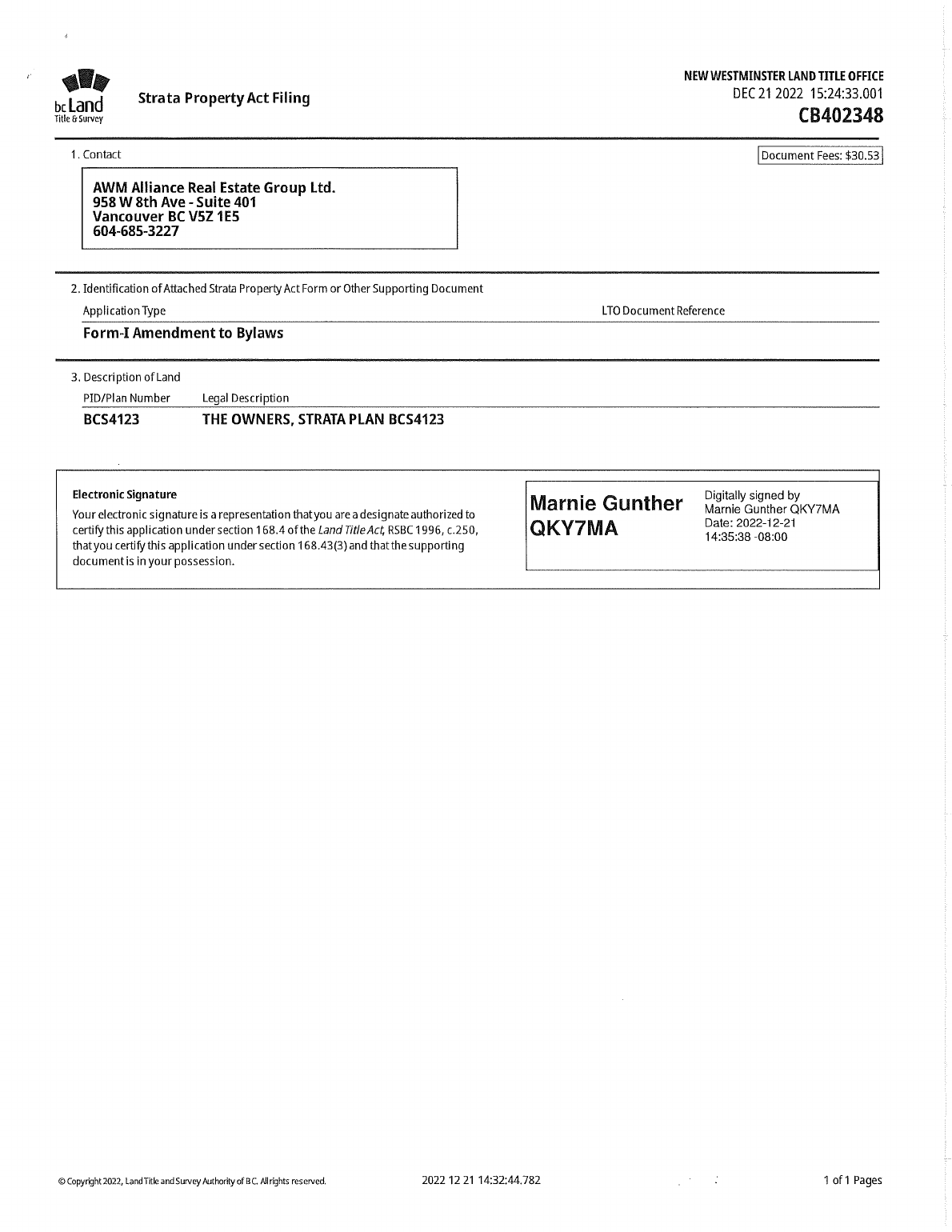
A 30-year capital-replacement plan identifying every major building component (roof, envelope, elevators, plumbing, etc.) with estimated remaining life and replacement cost. Legally required for most BC stratas every 5 years. BC buyers have paid an average of $19,676 in special levies over a recent 10-year span, which is the real-world cost of deferred maintenance.
What to look for: Scheduled major repairs in the next 5 to 10 years, the funding strategy (CRF only, special levies, or a mix), and whether the strata is on the "recommended funding" path or a cheaper path that defers costs. Compare the current CRF balance against the report's recommended funding schedule, not just against the 10% statutory floor.
Red flags: Major projects due within 3 years but the CRF is below the recommended funding level; no funding strategy committed to; report older than 5 years. A CRF balance sitting at exactly the 10% minimum is a warning, not a comfort: 10% is the legal floor, not a healthy target for a mid-rise or aging building.
BONUS DOCUMENT · ENGINEERING REPORT
An engineering report is ordered by the strata only when a specific system (envelope, leak, structural) needs professional diagnosis. It's not part of the standard package, so many strata corporations don't have one, and that's normal. But when one exists, it's usually the most important document in the package.
What to look for: any engineer-recommended work that has NOT yet been done, and whether the funding for it is allocated or pending a vote.
Red flag: an engineer report recommending urgent envelope remediation with no approved funding plan is a buy-at-your-own-risk situation.
4. Meeting Minutes
There are 3 kinds of strata meeting records you need to read: Council Meeting Minutes, Annual General Meeting (AGM) Minutes, and Special General Meeting (SGM) Minutes. Notice Packages* ride along with AGMs and SGMs as a bonus, not a separate type. Together, these records are the real temperature of a building.
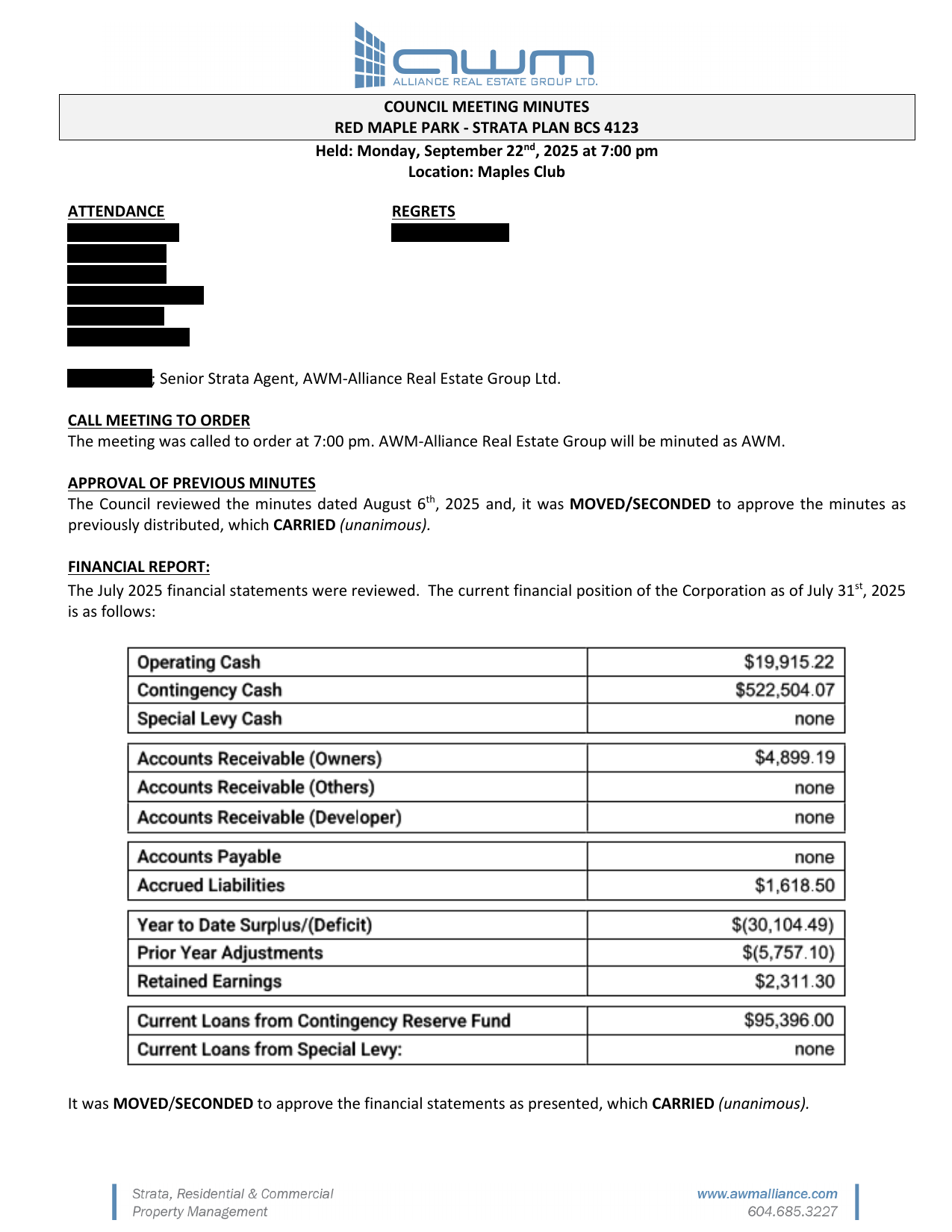
Council Meeting Minutes: The strata council (5 to 7 elected owners) meets monthly or quarterly to handle day-to-day business: bylaw complaints, maintenance quotes, insurance claims, contractor decisions, and upcoming project planning. Council Minutes are where repeat issues (water ingress, noisy owners, slow repairs) surface first and longest before any formal vote.
Annual General Meeting (AGM) Minutes: The AGM is held once a year within 2 months of the strata's fiscal year-end. All owners vote on the next year's operating budget, elect the incoming strata council, and approve or reject proposed bylaw amendments by 3/4 vote. This is the highest-stakes meeting in the strata calendar, and the minutes confirm what actually passed.
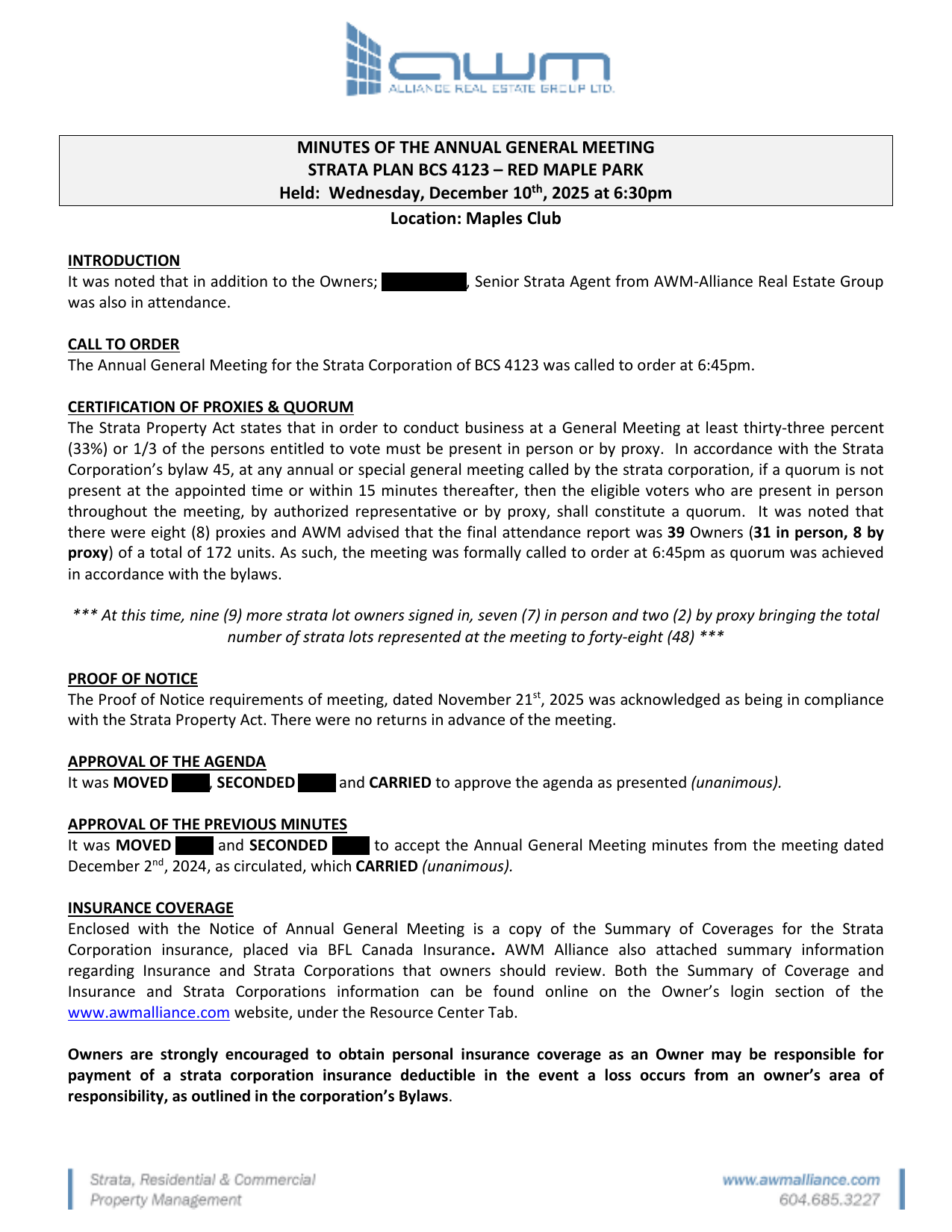
Special General Meeting (SGM) Minutes: An SGM is called between AGMs whenever the strata needs an urgent owner vote, typically to approve a special levy, amend a bylaw mid-year, or respond to a legal matter. If you see an SGM in the last 12 months, read those minutes first: they almost always involve money, urgency, or both.
* Notice Packages: Not a separate meeting record, but worth flagging on its own. A notice package is sent to owners 2 to 8 weeks before each AGM or SGM. It contains the proposed resolutions, supporting engineer reports, budget worksheets, and any documents the minutes reference by name. The minutes record what passed; the notice package explains what was actually being voted on. Rush strata packages often omit the notice packages, which is itself a red flag.
Council Meeting Minutes
AGM Minutes
SGM Minutes
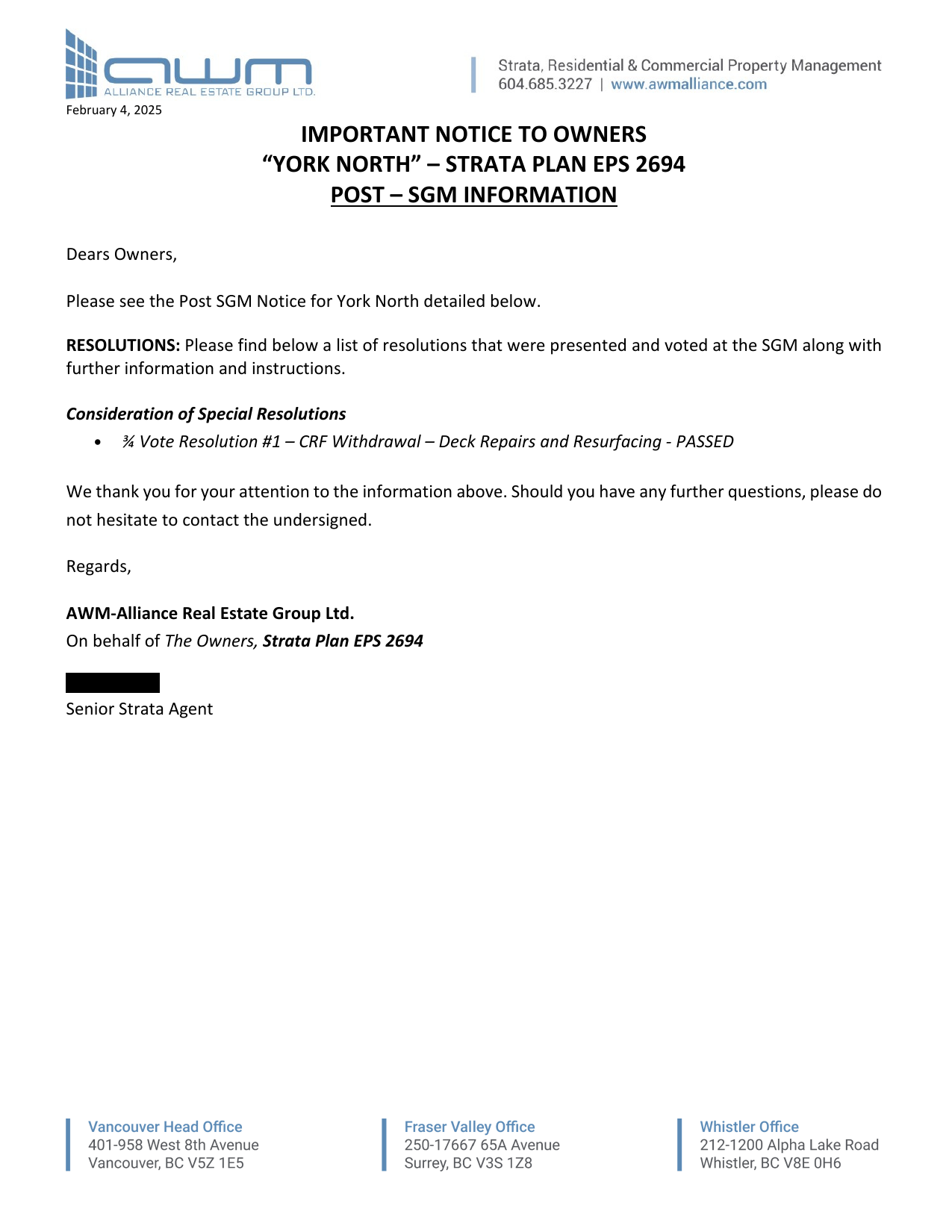
Council and AGM minutes from Red Maple Park (Langley, BCS 4123); SGM minutes from York North (Langley, 2025-02-03). Click any to open the full scrollable PDF.
What to look for: Across all four document types, look for: repeat complaints (water, noise, pest), recurring budget shortfalls, delayed votes on major projects, the tone of owner-vs-council discussion, and notice packages missing from the bundle. Cross-check notice-package resolutions against the corresponding AGM or SGM minutes to confirm what actually passed and what was deferred.
Red flags: Multiple water-ingress or building-envelope discussions without resolution; high council turnover; owners repeatedly voting down recommended maintenance; notice packages missing entirely (request them before removing subjects); an SGM in the last 12 months that you have not been given minutes for.
5. Financial Statements & Operating Budget
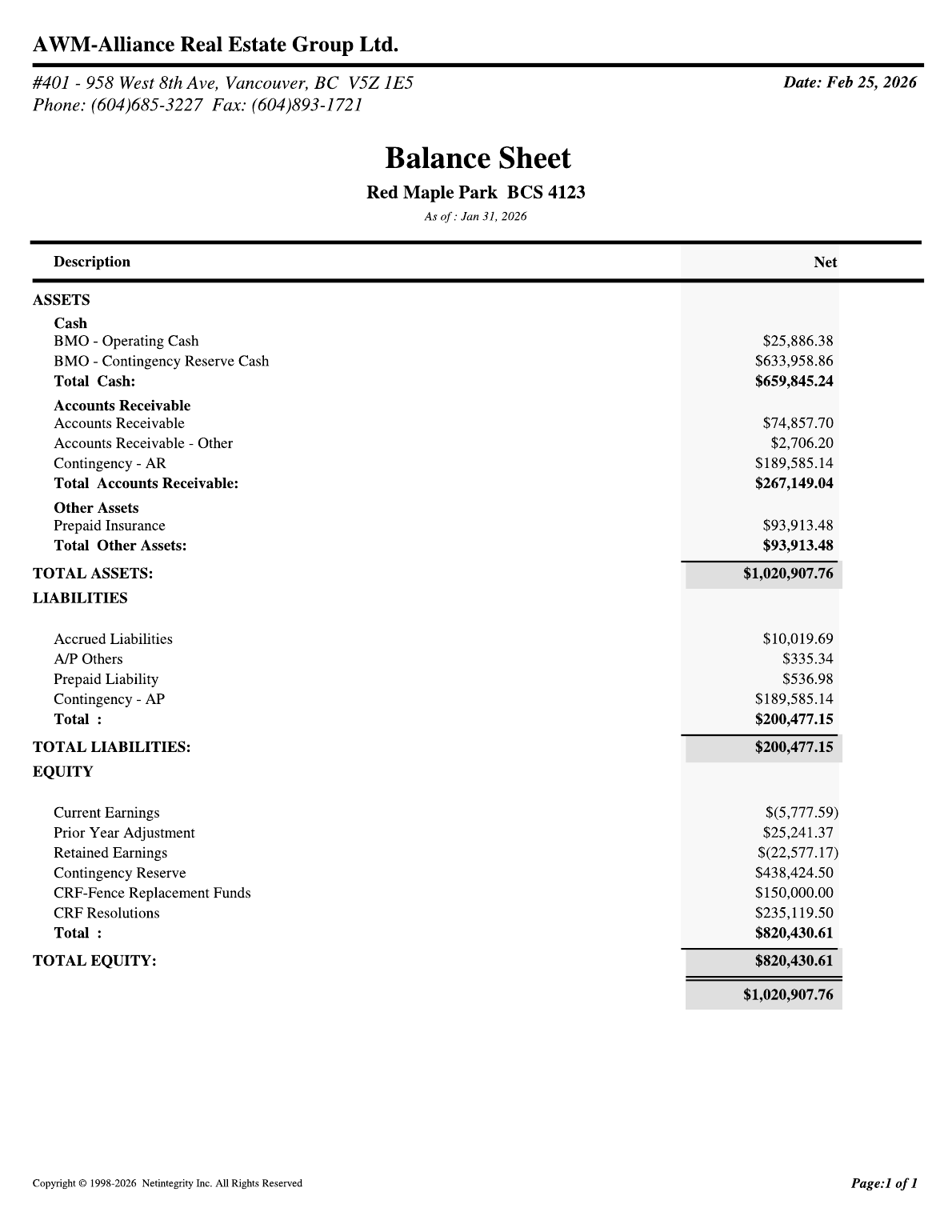
The annual operating budget plus year-to-date financials. Tells you if the strata is spending within its means, how much it's contributing to the CRF each year, and whether the budget is being "padded" to hide weakness. Under section 105(2) of the Strata Property Act, a strata can use the CRF to cover an operating-fund deficit , legal, but a sign that fees are priced below the true cost of running the building.
What to look for: Operating-fund surplus or deficit at year-end, CRF balance trend over the last 3 years, monthly strata fee as % of the overall operating budget, and any line item labelled "surplus carry-forward" or "prior-year surplus applied to budget". The latter is how a strata can make an unbalanced budget look balanced for the current year.
Red flags: Repeated operating-fund deficits being covered by CRF; CRF balance declining year over year; strata fees below the Fraser Valley mid-rise norm of roughly $0.35 to $0.55 per sqft per month; "padded" budgets that rely on a prior-year surplus to close the current-year gap (the surplus runs out, the shortfall doesn't).
6. Insurance Summary
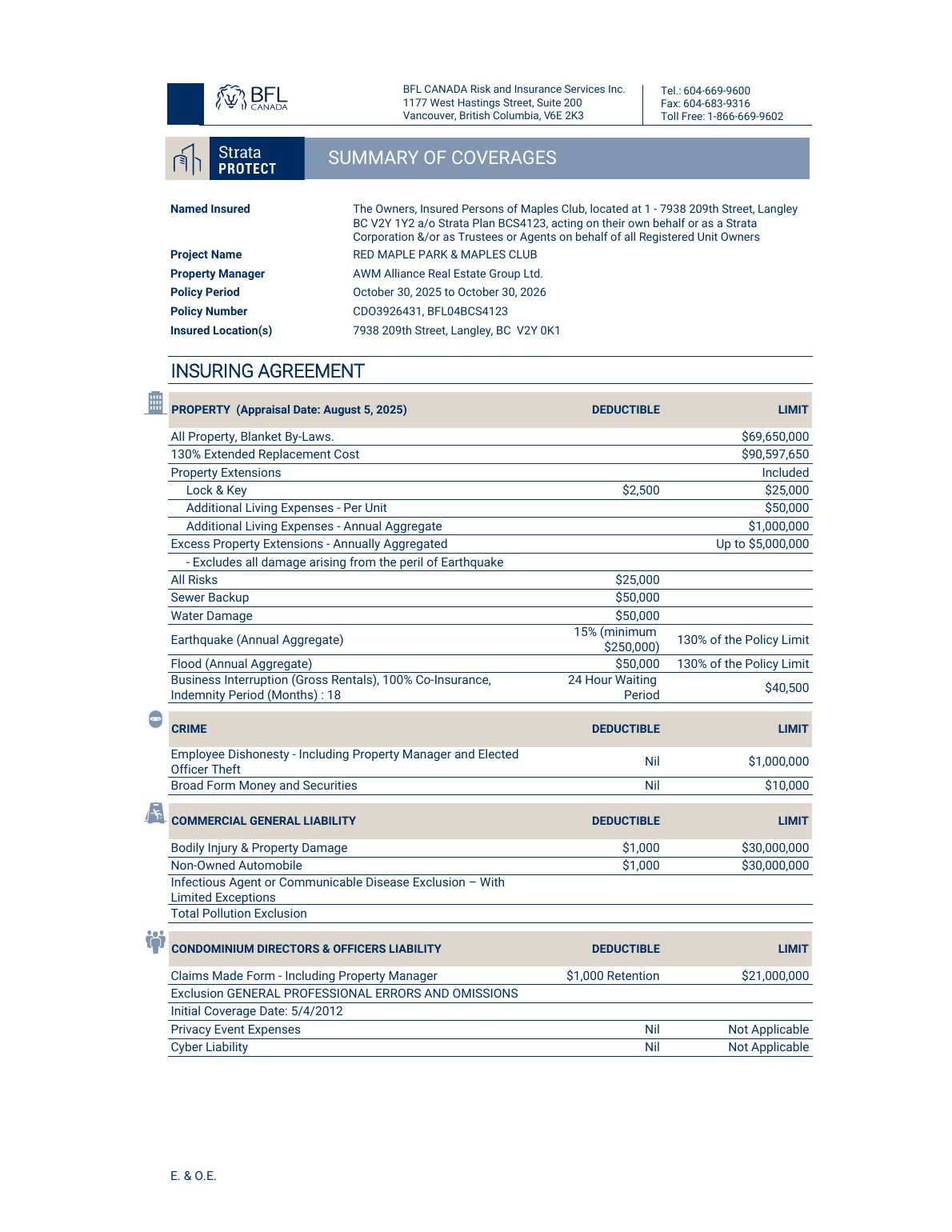
The strata's current property and liability coverage, including deductibles. Deductibles matter because a strata can pass them on to an at-fault owner. Earthquake is the coverage most BC buyers assume is included and often isn't: it is a separate, optional peril, and the average earthquake deductible across BC strata policies is roughly $56,000.
What to look for: Building replacement cost, water-damage deductible (typical range $25,000 to $100,000), whether earthquake is a listed peril (not assumed), the earthquake deductible if it is listed, and total liability limit. Confirm the strata's bylaws require owners to carry personal condo insurance covering the unit deductibles.
Red flags: Water-damage deductible above $50,000 combined with no owner-level deductible insurance requirement in the bylaws; earthquake coverage missing entirely or carrying a deductible above the $56,000 BC average; any recent deductible increase without explanation in the minutes.
Acceptable Range
$25,000 to $100,000
Typical strata deductibles in BC fall in this window. Confirm your personal condo insurance covers the full deductible amount.
Red Flag
Above $100,000
Deductibles over $100,000 are a red flag. Either the building has a loss history or the insurer is pricing it as high-risk.
Common Mistakes Buyers Make
- Reading only the Form B: the Form B is a snapshot. The story is in Minutes, Depreciation Report, and Financials. A clean Form B can mask a building with a $40,000 special levy pending.
- Waiving subject-to-docs for a 2-day review window: strata packages can run 300+ pages. Ask for 7 business days at minimum, never fewer than 3.
- Skipping the Insurance Summary: a $100,000 water-damage deductible means a single bathtub overflow on the unit above yours can be billed to you in full if the bylaws don't require owner-level deductible coverage.
- Assuming all bylaws are enforceable: rental restrictions and most age restrictions were removed in 2022 and 2023. Reading a restrictive bylaw without checking current enforceability causes buyers to walk from deals they shouldn't have.
- Not asking for the last 2 years of Minutes: many sellers provide only the last AGM. The SGMs and council meetings in between are where the real arguments live.
- Trusting the package is complete: industry reviewers report that 90%+ of strata packages arrive missing at least one required document (notice packages, updated Depreciation Report, recent engineering report, current insurance summary). Always cross-check the package contents against the Form B attachment list and the registered strata plan at the Land Title Office before signing subjects off.
What to Do When You Find a Red Flag
Red flags in strata documents aren't automatically deal-killers. They're information. What matters is what you do with them.
- Quantify the risk: if a special levy is hinted at in Minutes, what's the likely dollar amount? Who's paying: all owners, or only affected units? When is the vote?
- Ask the seller through your realtor: most legitimate flags are explainable. A good seller will share the engineering report that contextualizes an envelope discussion. A seller who won't or can't is telling you something.
- Price the risk into your offer: if a $30,000 special levy is pending in 18 months, you can legitimately adjust your offer down by that amount (or negotiate a price-protection clause).
- Walk when the unknowns exceed the knowns: if after the full document review you still can't quantify what you're walking into, that's the signal to pass. There will always be another unit.
For buildings with complex strata histories (envelope remediation, pending litigation, unresolved water-damage disputes), a professional strata document reviewer costs $300 to $600 and delivers a written report you can use. It's the best cheap insurance in a condo purchase.
Frequently Asked Questions
How many days do I have to review strata documents after making an offer?
Most BC offers include a 5 to 10 business-day subject-removal window that covers document review. In a hot market the timeline can be as short as 3 business days. Ask for 7 at minimum, and never waive your subject-to-docs clause on a strata purchase.
Can I just read the Form B and skip the rest?
No. The Form B is a snapshot, but the story is in the Minutes, Depreciation Report, and Financials. A clean Form B can mask a building with recurring water damage, underfunded CRF, or contested major repairs documented in the Minutes.
Are rental restrictions still enforceable in BC?
No. As of November 2022, the BC government removed strata corporations' authority to restrict rentals. Bylaws that still contain rental restrictions are unenforceable (with narrow exceptions). If a bylaw still reads like a rental restriction, treat it as historical, not binding.
What about 55+ age restrictions?
Largely gone. The May 2023 update to the Strata Property Act removed age-based restrictions except for "55+" communities, and even those are narrowly defined. If you see an age bylaw, confirm its current enforceability with your realtor and lawyer before buying.
How old is too old for a Depreciation Report?
BC legislation requires most stratas to update the Depreciation Report every 5 years. A report older than 5 years is a red flag: either the strata has opted out (via a 3/4 vote), or the update is overdue. Ask for the most recent updated version before you sign.
What's the single biggest red flag in strata documents?
An engineer report recommending urgent envelope remediation without an approved funding plan. That combination tells you a major special levy is coming, the owners haven't agreed how to pay for it, and as the new owner you'll inherit that fight on day one.
Do I really need to read all of this?
You don't have to read every page, but you do need someone to. That's either you, your realtor, or (for complex buildings) a professional strata document reviewer. The $300 to $600 for a professional review is trivial next to a $20,000 special levy you didn't see coming.
Is a bare land strata the same as a regular strata?
No. In a bare land strata (common in townhome and detached-home complexes), each owner owns the building on their lot outright, and the strata corporation manages only the common areas (roads, amenities, landscaping). Depreciation reports and insurance summaries still apply, but the scope is narrower. You still review the same 7 documents, but Form B, Bylaws, Minutes, and Financials carry most of the weight.
What happens if the previous owner made unauthorized alterations?
You inherit them. Unauthorized alterations (a renovated bathroom, changed flooring, altered parking-stall layout, added HVAC) become the new owner's responsibility once the sale closes. Check the Form B for any "alteration in progress" or "alteration dispute" entries, and scan the Minutes for references to the unit number. If you find one, require the seller to resolve it (or grant a price reduction) before you remove subjects.
Buying or Selling a Condo or Townhome?
I'll read the strata package with you before you sign.
I've read hundreds of strata packages across the Fraser Valley. Book a call and we'll walk through the documents together, or grab my free Buyer's or Seller's Guide below.
Related Posts

Alex Dunbar Personal Real Estate Corporation
REAL Broker BC Ltd. | Living in the Lower Mainland
Buying, selling or investing in the Lower Mainland? Whether you're new to the area or a longtime local, I'll help you make the right move. Book a 30-minute no-pressure call with me and we'll go over your goals, timeline and budget.
Featured Guides
BC strata legislation and document-review practices change. Verify current rules with your realtor and lawyer before making any purchase decision. This article is for informational purposes only and does not constitute financial, legal, or investment advice.
Categories
Recent Posts




GET MORE INFORMATION