
Should You Buy a Home Near the New Surrey-Langley SkyTrain Extension?
Watch the full breakdown above, or read the station-by-station 2026 written version below.
In This Guide
Station-By-Station, Plus Timing And Mistakes
At a Glance
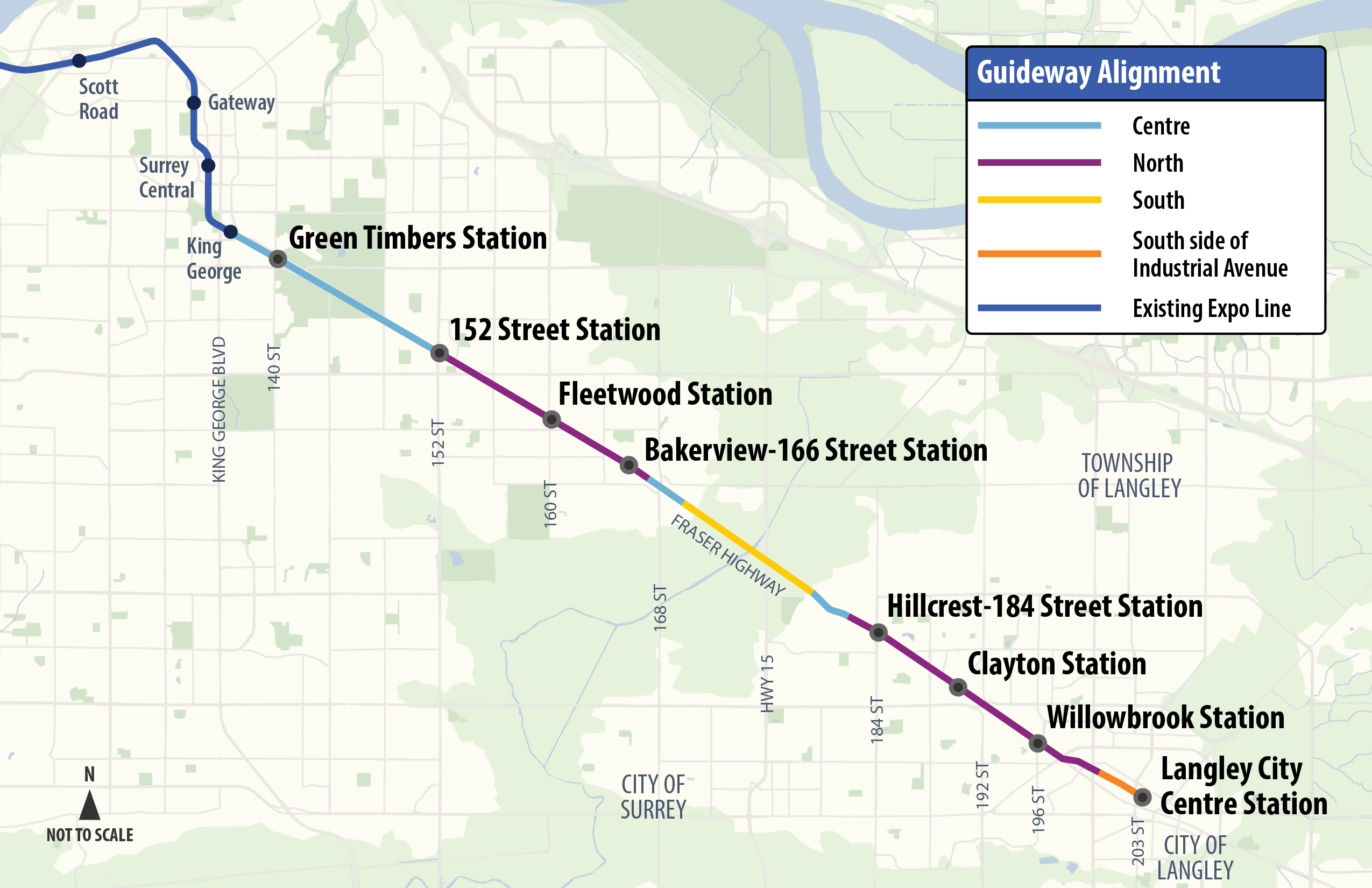
The 8 New Surrey-Langley SkyTrain Stations
STATION 01 · SURREY
Green Timbers Station →
Fraser Hwy at 140 St
STATION 02 · SURREY
152 Street Station →
Fraser Hwy at 152 St
STATION 03 · SURREY
Fleetwood Station (160th Street) →
Fraser Hwy at 160 St
STATION 04 · SURREY
Bakerview-166 Street Station →
Fraser Hwy at 166 St · Transit Exchange
STATION 05 · SURREY
Hillcrest-184 Street Station →
Fraser Hwy at 184 St
STATION 06 · SURREY
Clayton Station (190th Street) →
Fraser Hwy at 190 St
STATION 07 · LANGLEY TOWNSHIP
Willowbrook Station (196th Street) →
Fraser Hwy at 196 St / Willowbrook Dr · Transit Exchange
STATION 08 · LANGLEY CITY
Langley City Centre Station (203rd Street) →
Industrial Ave at 203 St · Transit Exchange
Line expected to open late 2029. Click any station to jump to its section.
Why SkyTrain Changes Your Buyer Math
A SkyTrain station does two things to the housing within walking distance: it lifts price per square foot, and it changes what developers are allowed to build. The first effect is what buyers notice. The second is what creates the long-term value.
EVERGREEN EXTENSION, FOR CONTEXT
The Millennium Line Evergreen Extension (Lougheed to Lafarge Lake-Douglas, through Port Moody and Coquitlam) opened in December 2016, and the condos around its stations rose quickly in the years that followed. No published study isolates the premium for homes near those stations, so treat the 10 to 20% walk-to-station premium often quoted for transit areas as a rule of thumb, not a forecast. Much of any lift tends to build in before opening.
Length
16 km
Total Cost
$6.0B
King George to Langley
22 min
Waterfront to Langley
62 min
Three rules apply to the Surrey-Langley extension:
- 400m is the sweet spot: a 5-minute walk is the durable premium zone. 800m is secondary. Beyond 800m, you are buying a neighbourhood with transit, not a transit-adjacent home.
- Transit-exchange and terminus stations lift more: Bakerview-166, Willowbrook, and Langley City Centre will outperform mid-corridor stops because they become regional nodes, not just neighbourhood stops.
- Zoning is the multiplier: every station has an Official Community Plan that governs how tall and dense the surrounding blocks can get. A station without aggressive upzoning will see less lift than one with a city-led densification plan.
With those rules in hand, the 8 stations break down into 3 tiers: high-leverage (aggressive upzoning + exchange status), mid-leverage (solid zoning but no exchange), and residential-lean (limited upzoning, quieter surroundings). The station-by-station breakdown below tags each one.
BC's New Zoning Rules: What the SkyTrain Unlocks on Your Lot
In late 2023, the BC government passed two housing laws that fundamentally changed what can be built near rapid transit: Bill 44 (Small-Scale Multi-Unit Housing, "SSMUH") and Bill 47 (Transit-Oriented Areas, "TOA"). Lots within 800m of a new station fall inside a Transit-Oriented Area once the city designates it, so check the TOA map for your block. If you are buying near a station, you are not buying the current zoning, you are buying the post-2024 upzoned version of that lot.
Transit-Oriented Area (TOA) vs Transit-Oriented Development (TOD): these two terms often get used interchangeably but mean different things. A TOA is the legal boundary defined by Bill 47 around a rapid transit station, inside which minimum densities are mandated by provincial law. A TOD is the actual built project (a tower, a 6-plex, a mid-rise) that gets approved and constructed inside a TOA. In short: TOA is the zoning rule; TOD is what gets built because of it. The SkyTrain creates the TOAs; Bill 44 and local developers deliver the TODs.
Bill 47 (TOA): High-Rise Density by Right
Transit-Oriented Areas (TOAs) are defined rings around every bus-exchange and rapid-transit station. Within each ring, municipalities cannot block developments up to a minimum density. Here is how the 3 tiers break down around SkyTrain stations:
TIER 1 · 0 TO 200M
20+ storeys
Min. 5.0 FAR · high-rise condo territory
TIER 2 · 200 TO 400M
12+ storeys
Min. 4.0 FAR · mid to high-rise
TIER 3 · 400 TO 800M
8+ storeys
Min. 3.0 FAR · mid-rise
FAR (Floor Area Ratio) is the ratio of total buildable floor area to lot area. 5.0 FAR on a 500 sqm lot = 2,500 sqm of floor area allowed.
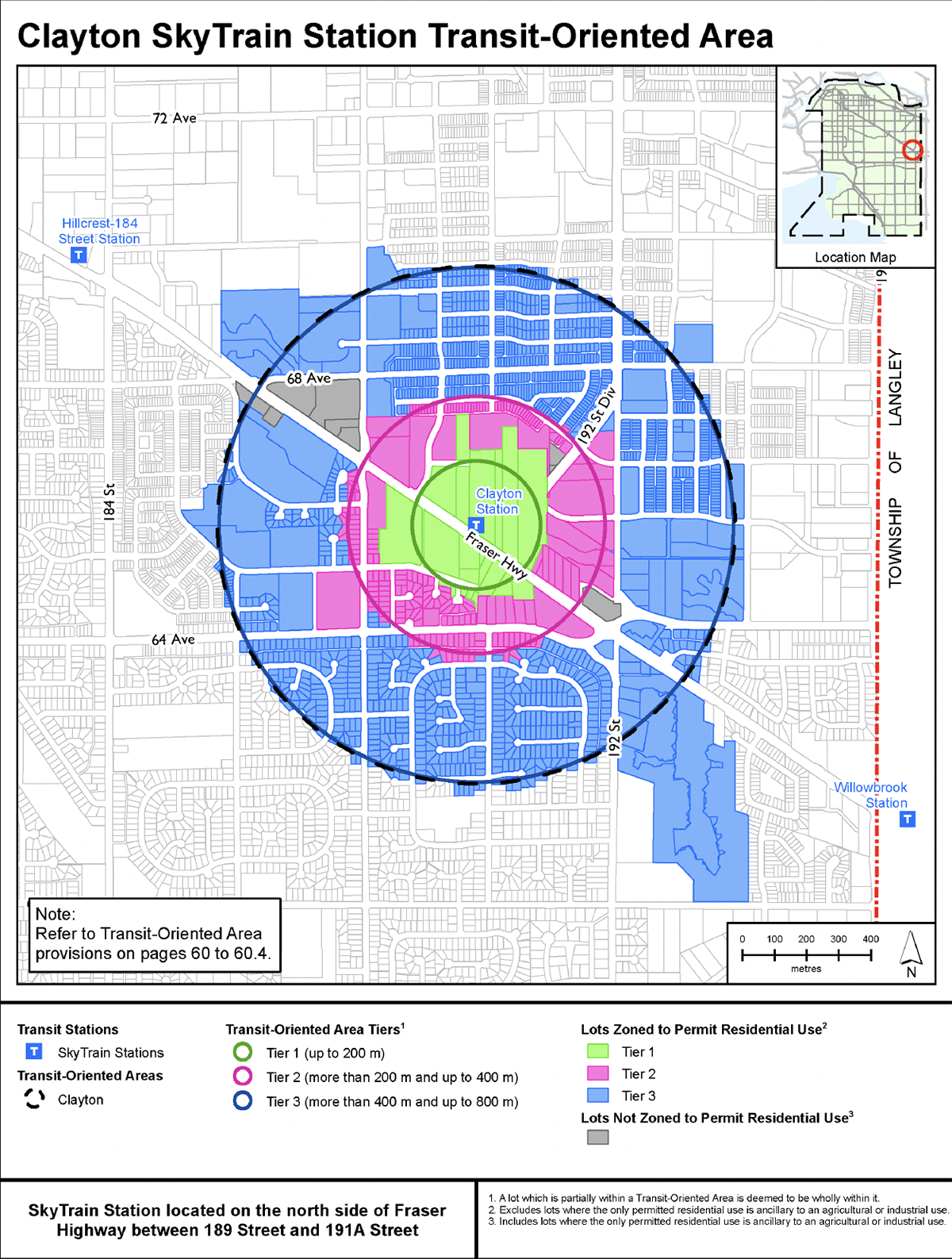
Bill 44 (SSMUH): Up to 6 Units on Any Single-Family Lot
Small-Scale Multi-Unit Housing is the law that matters for detached homeowners. On any lot currently zoned for single-family, municipalities must now allow:
- 3 to 4 units as the baseline minimum, everywhere in BC.
- Up to 6 units on lots 280 sqm or larger that also sit within 400m of a frequent transit stop (a stop with frequent bus service; inside a SkyTrain station’s Transit-Oriented Area, the TOA rules apply instead).
- Secondary suites plus detached dwellings (laneway / garden suites) on any lot , no longer at the municipality's discretion.
Practically, this means a Clayton or Fleetwood detached lot within 400m of the new station is no longer a "tear-down single-family home" , it is a 6-plex development site. Market pricing on those lots has already started reflecting the upzoned potential.
How Bill 44 And Bill 47 Interact
The two bills stack, they do not overlap. Bill 44 SSMUH sets the floor on every residential lot in BC; Bill 47 TOA raises that floor further inside the 800m catchment of a rapid transit station. Inside a TOA, the higher density applies:
- Tier 1 or 2 lot (within 400m of a station): Bill 47 mandates 12 to 20+ storey minimums, so the Bill 44 "up to 6 units" baseline is effectively superseded. The lot is a condo-tower development site, not a 6-plex site.
- Tier 3 lot (400 to 800m from a station): Bill 47 mandates 8+ storeys, still above the Bill 44 baseline. The SSMUH 6-plex rule is legally permitted but economically unlikely, because a developer can build much more density on the same lot.
- Lot beyond 800m from a station: TOA rules do not apply. Bill 44 SSMUH is the governing density rule. This is where you actually see 6-plexes built, because the 12-to-20-storey tower option is off the table.
The practical buyer takeaway: the more interesting redevelopment bet is often a Tier 3 (400 to 800m) lot on the edge of the TOA, not a Tier 1 lot at the station. Tier 1 lots get assembled into single large towers, which takes 5 to 10 years and favours institutional buyers. Tier 3 lots can be redeveloped individually on a faster timeline and are more accessible to retail investors.
What This Means For You As A Buyer
- Buying a detached lot in a Tier 1 or Tier 2 zone: you are buying a future tower site. Expect neighbour lots to be assembled and redeveloped within 10 years, which changes your view, traffic pattern, and eventual resale buyer pool.
- Buying a townhome or condo within 400m of a station: the TOA zoning protects you from downzoning but guarantees additional density will come. The question is whether your specific building lands on a lot that redevelops (less likely for newer stratas with active corporations) or gets preserved.
- Buying beyond 800m: you are outside the mandatory TOA rings but still inside SSMUH. The baseline is still 3 to 4 units allowed per lot, just without the 6-unit bonus. The neighbourhood feel shifts less dramatically, which some buyers actively prefer.
The 8 SkyTrain Stations, West to East
Stations are listed in the order trains will hit them travelling east from King George Station (existing terminus) toward Langley City Centre (new terminus). Each section includes the cross street, neighbourhood, an artist rendering of the completed station, and a pinned street map you can zoom in on.
1. Green Timbers Station (Surrey)
Fraser Hwy at 140 St · Surrey City Centre edge / Green Timbers Urban Forest
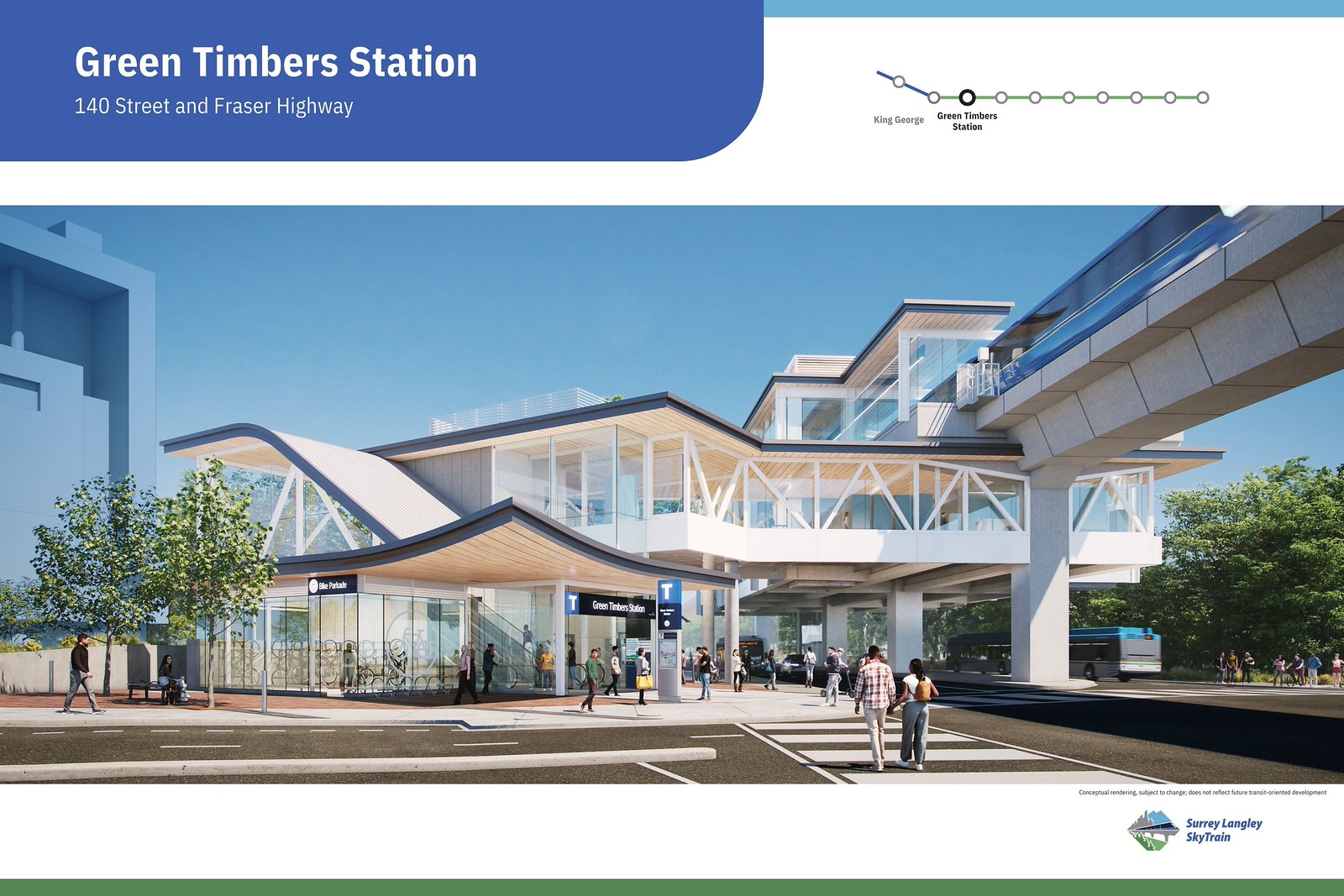
The westernmost new station sits on the eastern edge of Surrey City Centre, minutes from the existing King George Station and the Green Timbers Urban Forest. Buyers here get a rare combo: proximity to the fastest-densifying node on the extension plus an urban forest of about 230 hectares as a neighbour.
Current inventory: single-family homes and aging low-rise condos on the City Centre side, transitioning to green space at the forest edge.
Upzoning direction: high-rise condos between the forest and King George as Surrey's City Centre Plan pushes east.
What to watch for: heavy construction disruption along Fraser Hwy through 2029, and confirm you understand which side of Fraser Hwy you are on. The forest-facing side commands a premium over the commercial-strip side.
Green Timbers Station Station location , Fraser Hwy at 140 St
2. 152 Street Station (Surrey)
Fraser Hwy at 152 St · Green Timbers / Fleetwood-West
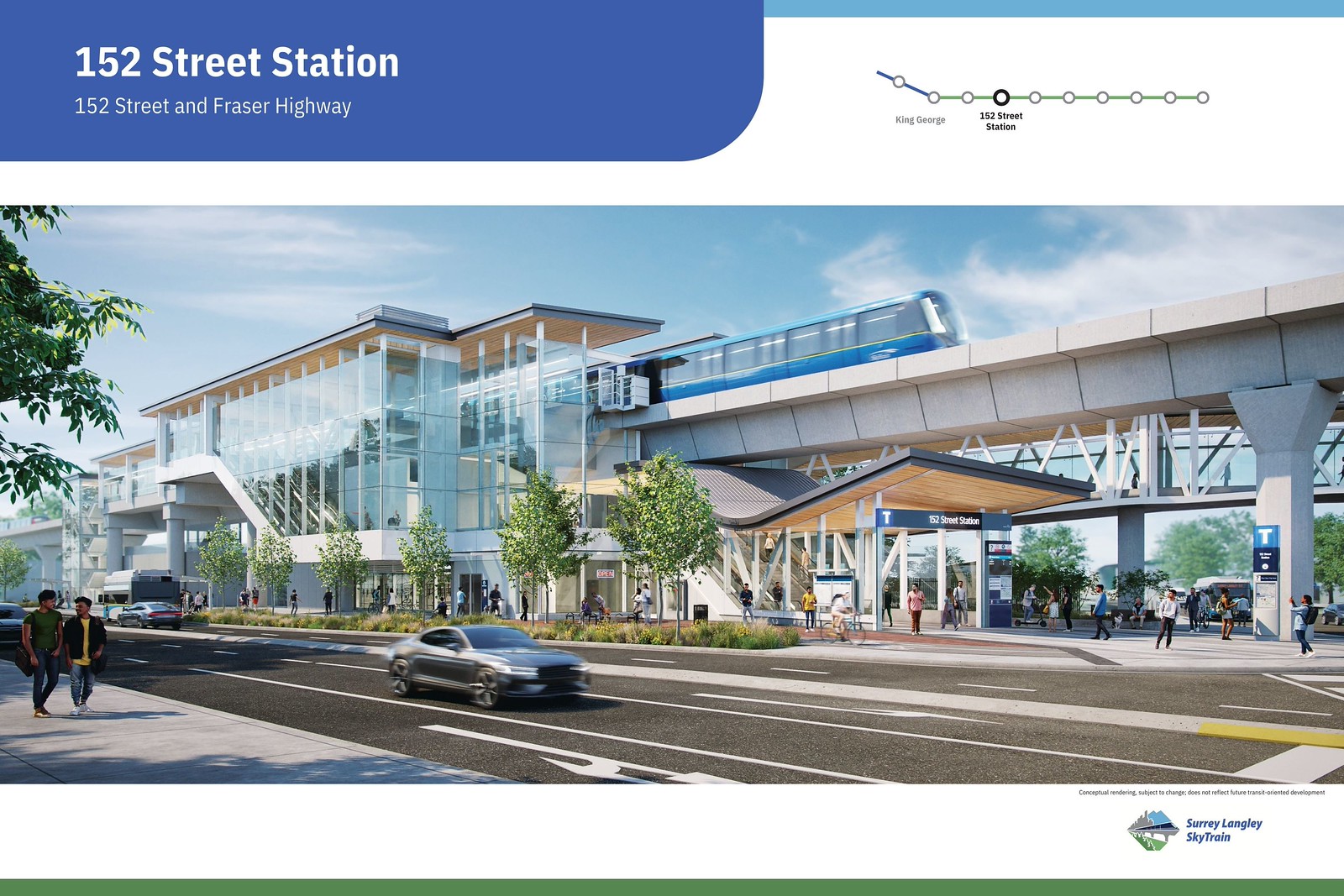
A mid-corridor station on the boundary between Green Timbers and western Fleetwood. The product mix is still mostly 1970s and 1980s detached homes, which means this station is a rezoning bet as much as a transit bet.
Current inventory: single-family homes (older stock) with emerging townhome developments on side streets.
Upzoning direction: mid-rise condos and transit-oriented development within a 400m radius of the station, per Surrey's Fleetwood Plan updates.
What to watch for: lots that front Fraser Hwy will be targeted for assembly. If you see a run-down 1970s detached in this zone, it is not a starter home opportunity, it is a developer's land bank in waiting.
152 Street Station Station location , Fraser Hwy at 152 St
3. Fleetwood Station (160th Street) (Surrey)
Fraser Hwy at 160 St · Fleetwood town centre
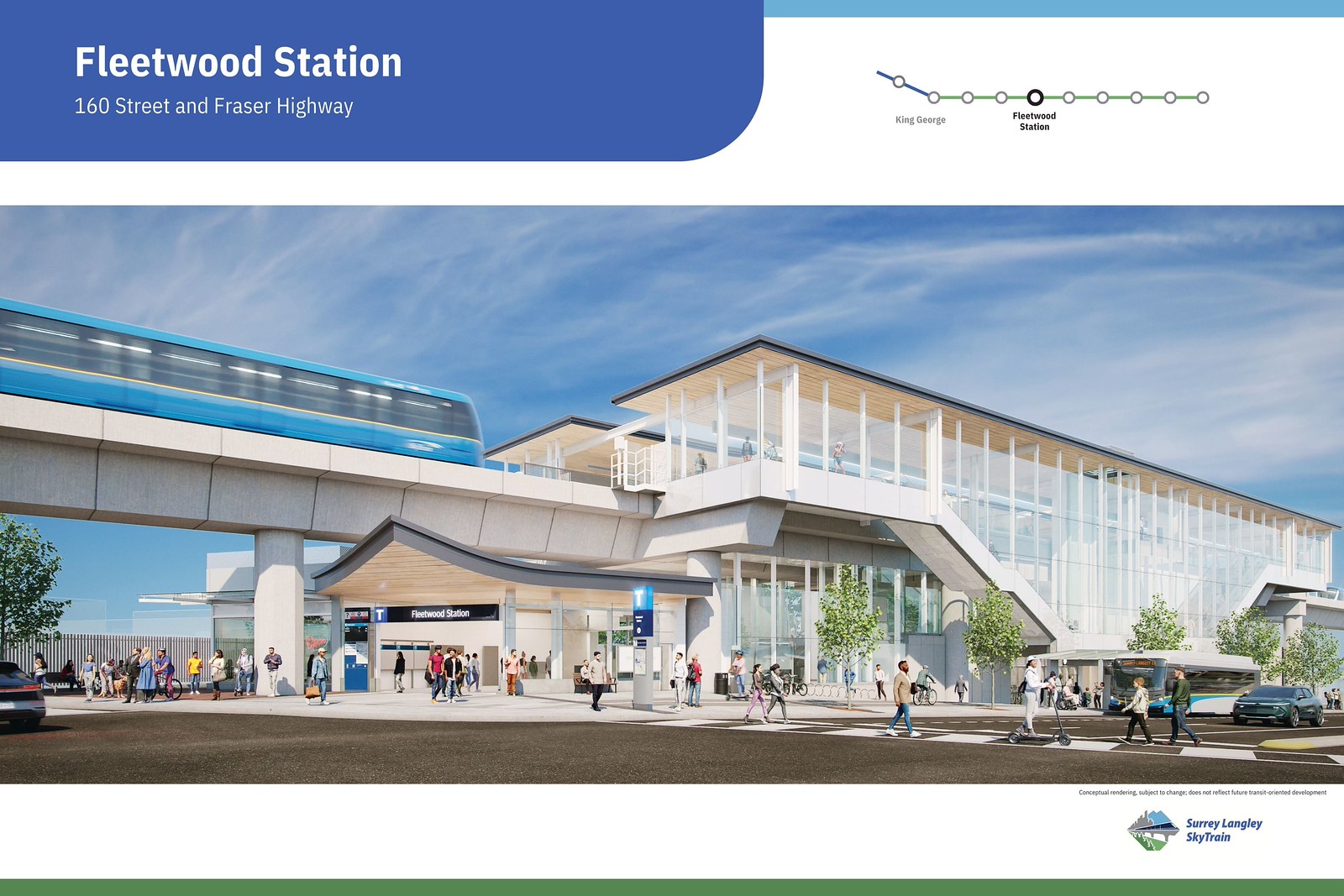
The heart of Fleetwood sits right at 160 St. Surrey's Fleetwood Plan has been anticipating this station for a decade and pre-zoned much of the surrounding land for high-rise condos.
Current inventory: single-family dominant today, with a handful of newer mid-rises near the Fleetwood Community Centre.
Upzoning direction: high-rise condos within a 400 to 800m radius. This is the most aggressively pre-sold station on the entire extension.
What to watch for: pre-sale pricing here already assumes a SkyTrain premium. Compare $/sqft at Fleetwood pre-sales against established Surrey City Centre buildings, and calibrate your offer accordingly.
Fleetwood Station (160th Street) Station location , Fraser Hwy at 160 St
4. Bakerview-166 Street Station (Surrey)
Fraser Hwy at 166 St · Fleetwood town centre (eastern edge) · Transit Exchange
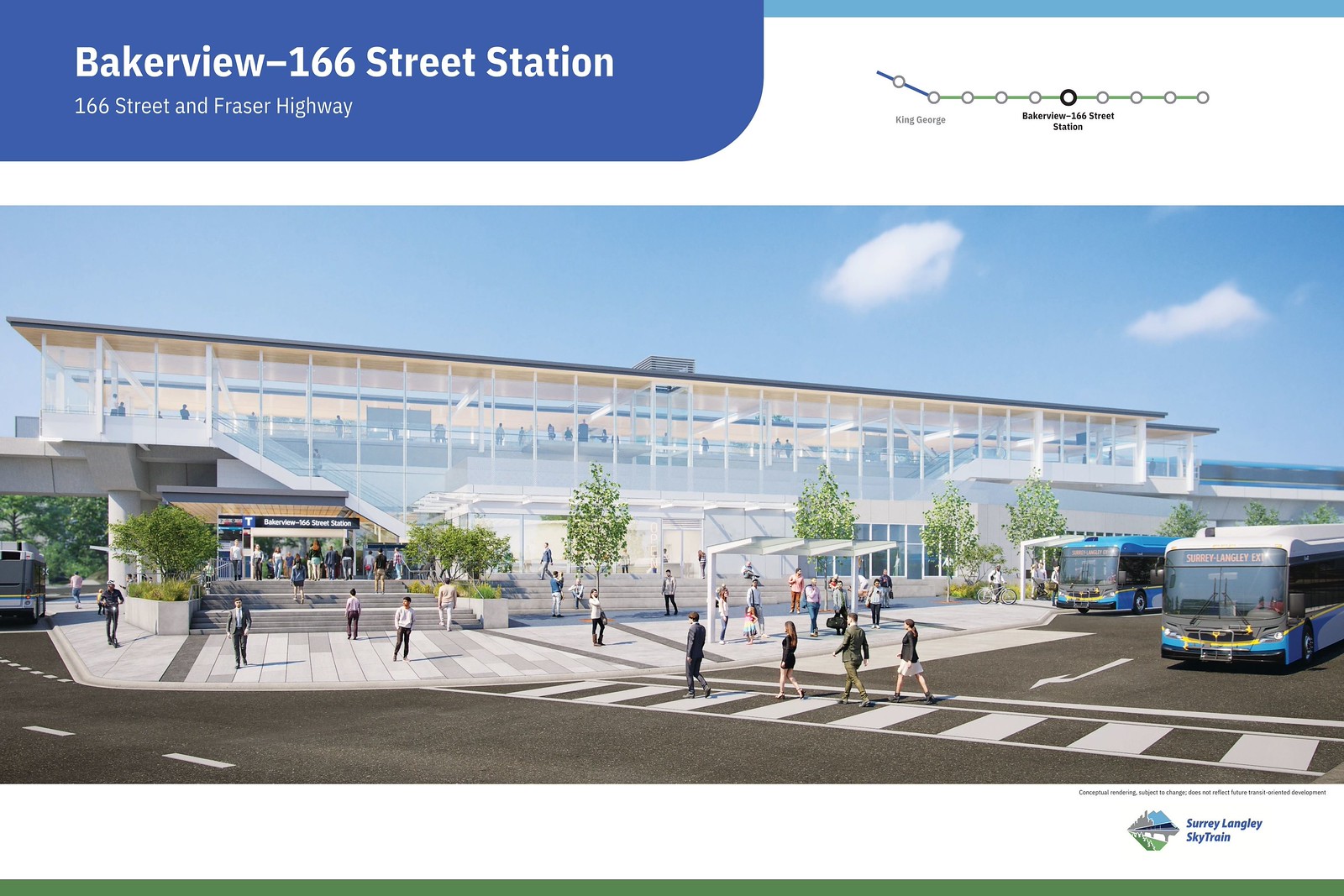
A transit-exchange station, meaning multiple bus routes will terminate here. That distinction matters for buyers: transit exchanges command a measurable premium over standard stations because they become regional nodes, not just neighbourhood stops.
Current inventory: single-family plus emerging townhome pockets in the surrounding Fleetwood east pocket.
Upzoning direction: high-rise and mid-rise condos, with bus-access site planning that tends to produce taller, denser towers than non-exchange stations.
What to watch for: the bus-loop side of the station is the less desirable side for long-term residential value. The opposite-of-the-bus-loop side is where the premium condos will cluster.
Bakerview-166 Street Station Station location , Fraser Hwy at 166 St
5. Hillcrest-184 Street Station (Surrey)
Fraser Hwy at 184 St · Hillcrest / Clayton border (Cloverdale)
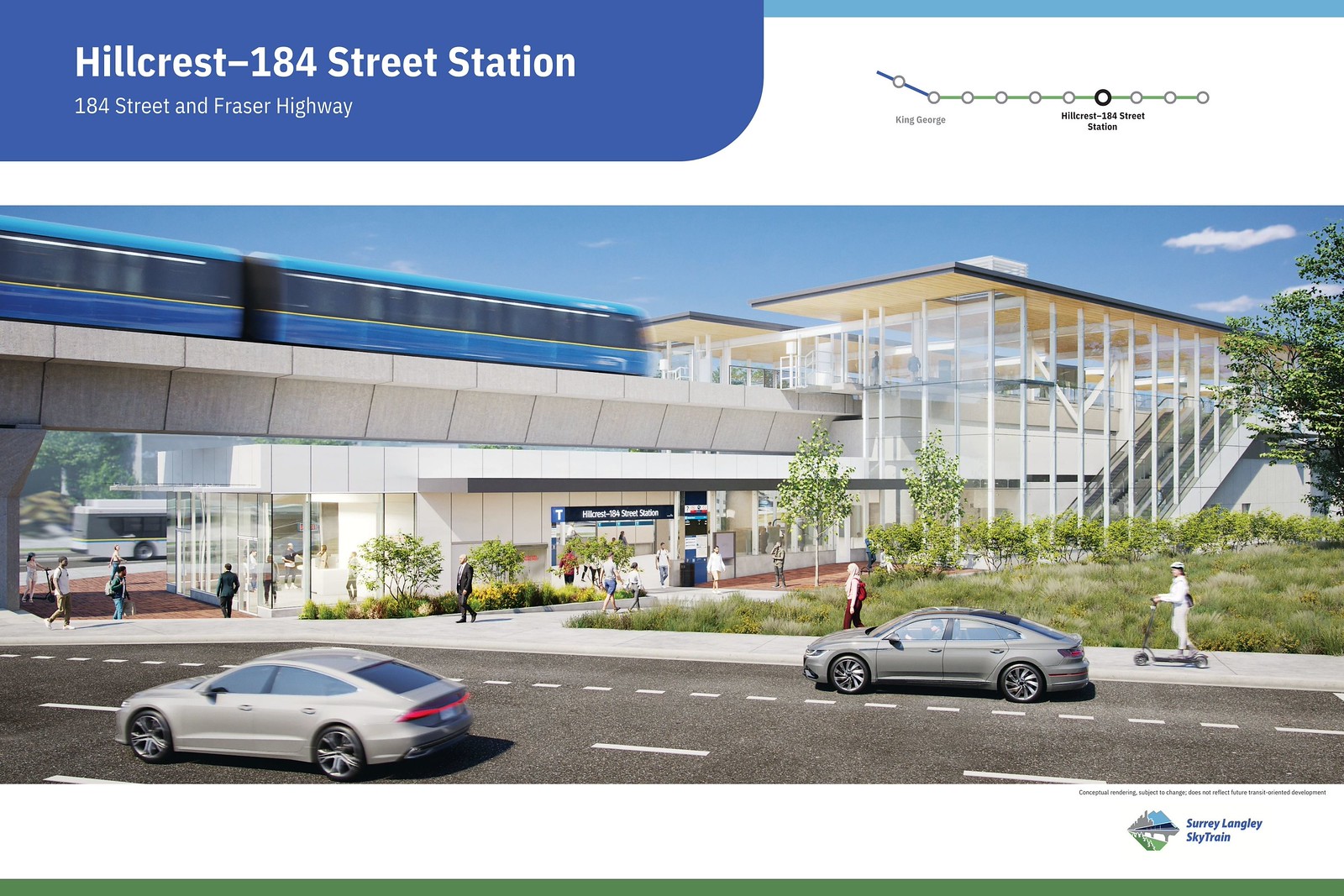
Midway between Fleetwood and Clayton, Hillcrest is the quietest station on the extension. There is no transit exchange, less commercial density, and the product mix leans residential. Think of this as the commuter's station: lower stop-level bustle, higher residential-quality surroundings.
Current inventory: single-family Hillcrest homes on the north side; Clayton Heights townhomes and new SFH on the south side.
Upzoning direction: mid-rise condos and townhome infill within a 400m radius. Less aggressive than Fleetwood or Clayton.
What to watch for: this station favours buyers who want SkyTrain access without SkyTrain density. Expect slower price lift than the exchange stations, but a more residential neighbourhood feel long-term.
Hillcrest-184 Street Station Station location , Fraser Hwy at 184 St
6. Clayton Station (190th Street) (Surrey)
Fraser Hwy at 190 St · Clayton Heights / Cloverdale
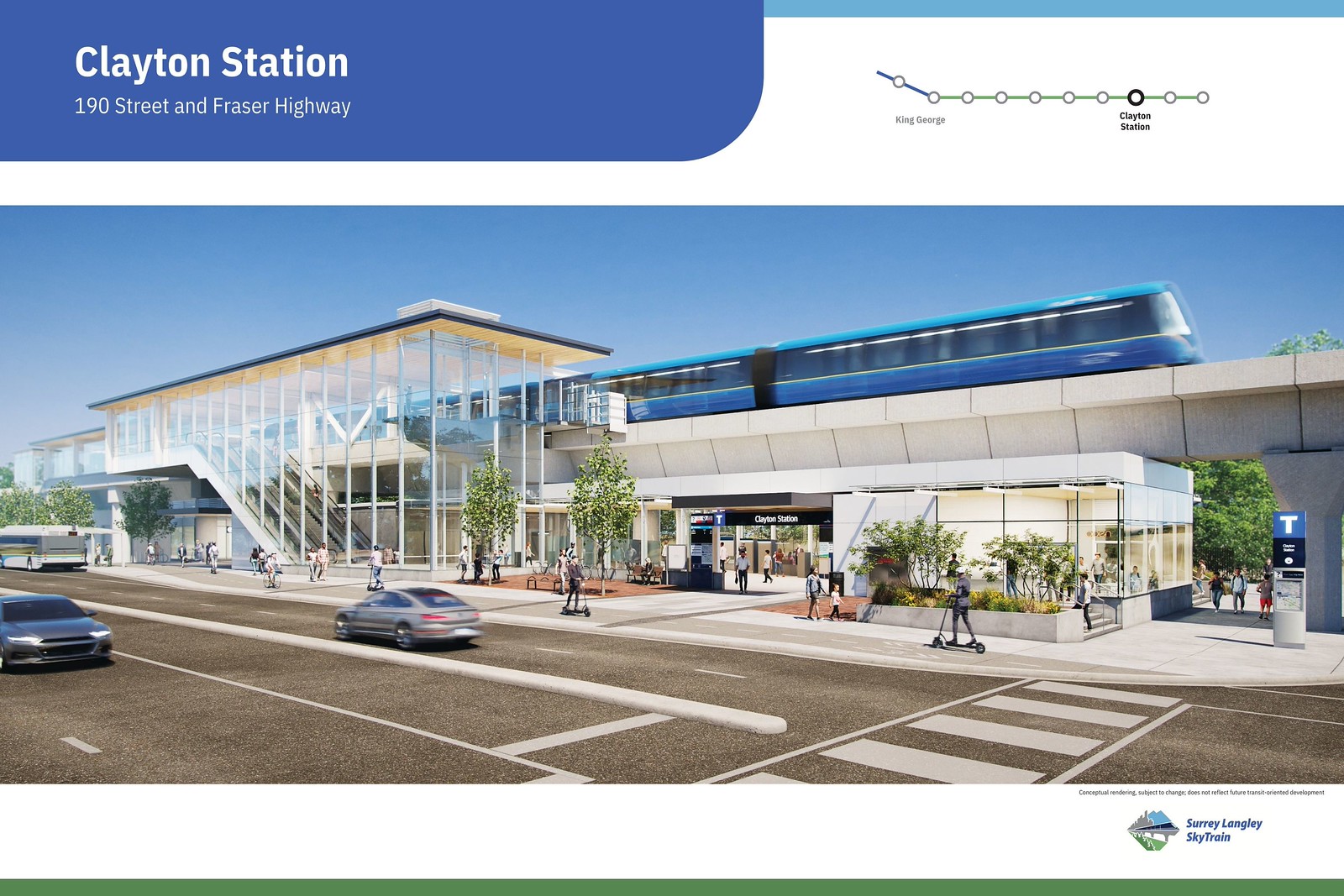
Clayton Heights has been one of the Fraser Valley's most active townhome markets for a decade, and the new 190 St station slots right into the centre of it. Unlike most stations on the extension, the existing product mix here is already dense: mostly townhomes, not single-family.
Current inventory: townhome dominant (Clayton Heights), with single-family pockets and a large daycare/school catchment.
Upzoning direction: mid-rise condos and additional townhome infill. Existing Clayton townhomes hold their premium well and do not need to wait for densification to pay off.
What to watch for: Clayton townhomes are already trading at a SkyTrain-adjacent premium. If you buy here, you are paying for proximity now rather than betting on a future lift. Budget accordingly and compare against non-SkyTrain Cloverdale townhomes on ROI.
Clayton Station (190th Street) Station location , Fraser Hwy at 190 St
7. Willowbrook Station (196th Street) (Langley Township)
Fraser Hwy at 196 St / Willowbrook Dr · Willowbrook (big-box retail district) · Transit Exchange
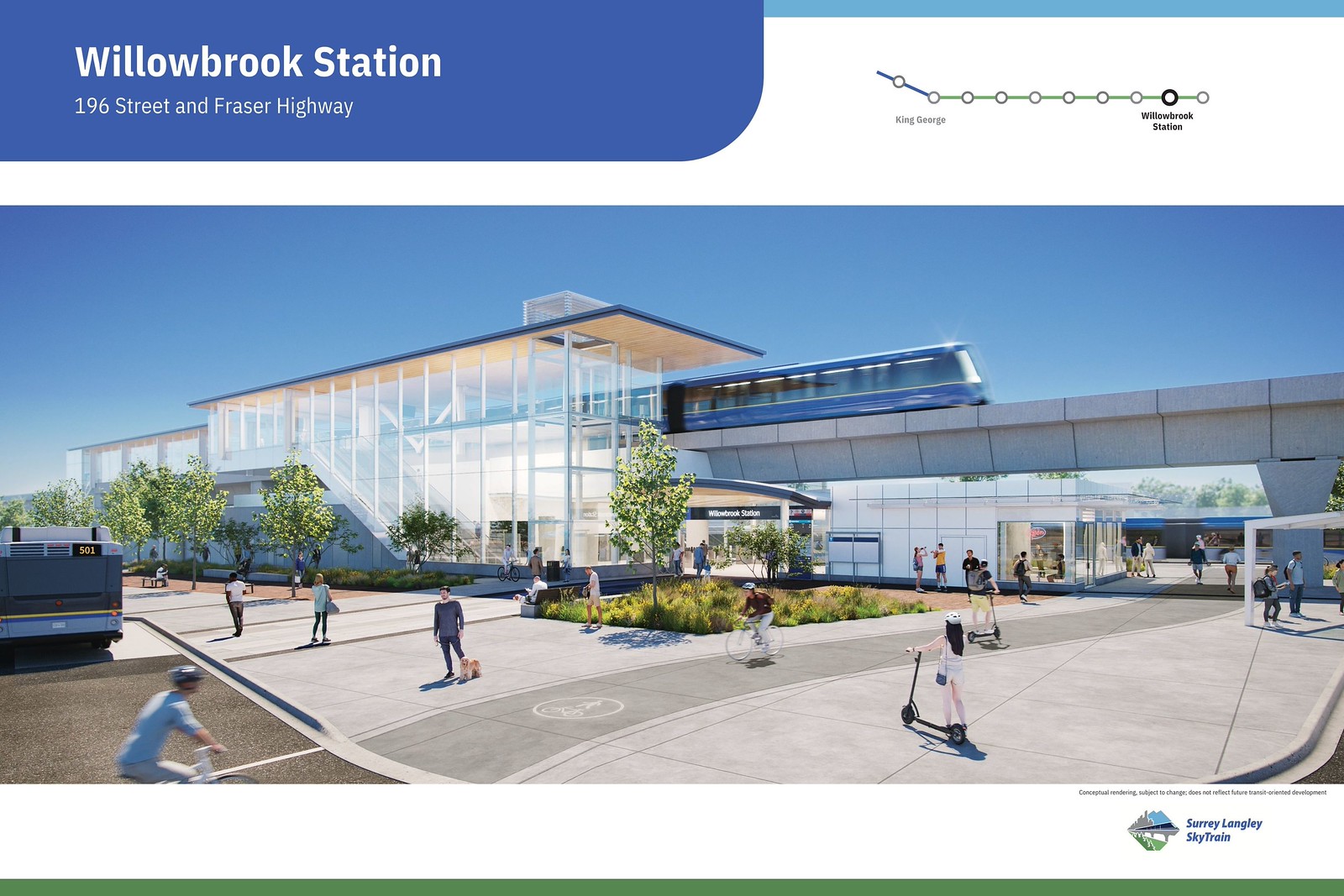
The first Langley station and the biggest transit-exchange node east of Surrey Centre. Willowbrook Shopping Centre and the surrounding big-box retail make this the regional anchor for north-of-Fraser-Hwy Langley. The Willowbrook Master Plan already zones the area for high-rise condos.
Current inventory: townhomes and low-rise condos mixed with big-box retail and older commercial strips.
Upzoning direction: high-rise condos under the Willowbrook Master Plan, with the shopping-centre lands slated for phased redevelopment over the next 15 years.
What to watch for: pre-sale activity around Willowbrook is heating up fast. Buy close enough to walk (400m or less) but not directly above big-box retail loading zones: the noise and traffic trade-off is real.
Willowbrook Station (196th Street) Station location , Fraser Hwy at 196 St / Willowbrook Dr
8. Langley City Centre Station (203rd Street) (Langley City)
Industrial Ave at 203 St · Downtown Langley City / Innes Corner · Transit Exchange
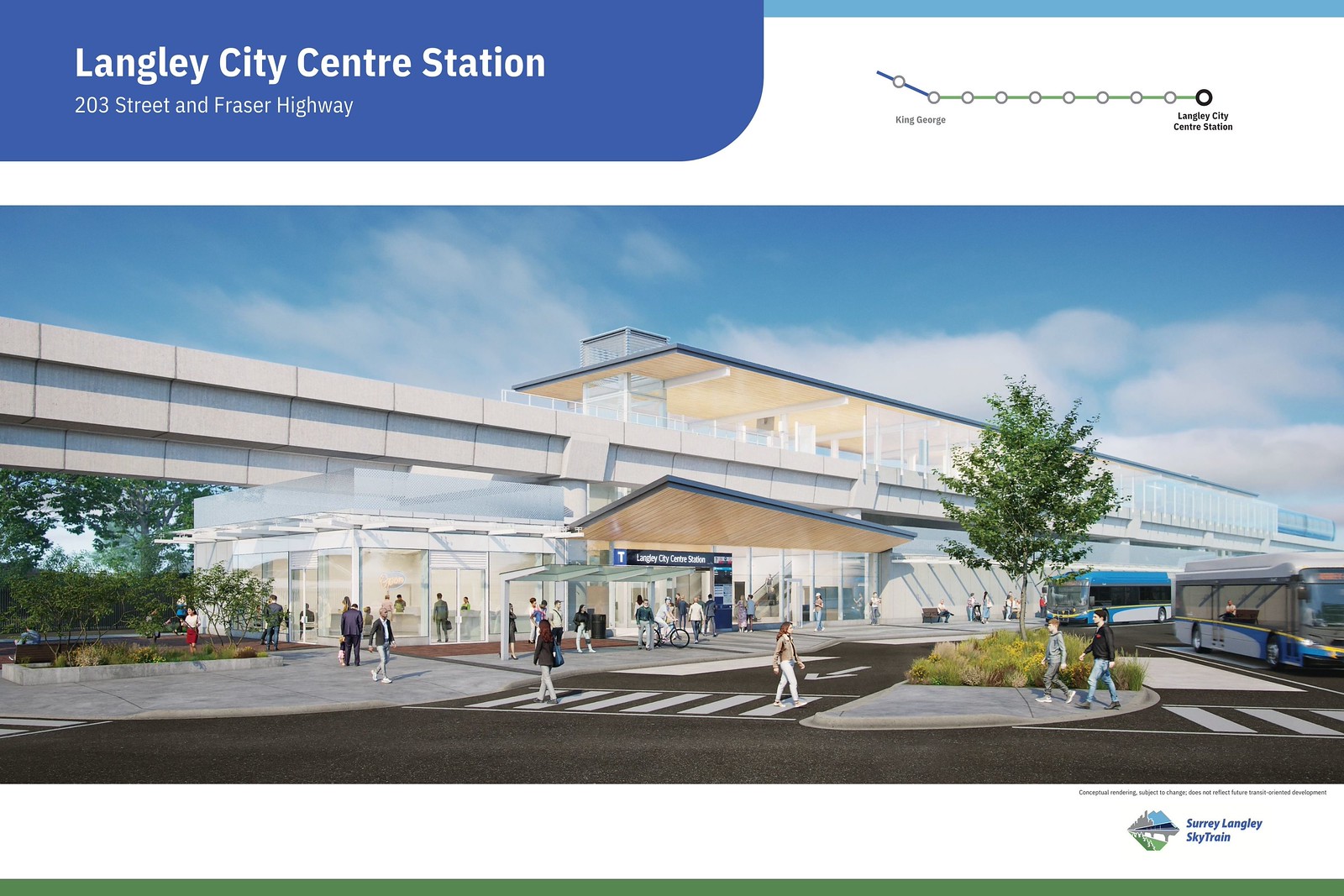
The eastern terminus. Every rider coming off this station is either starting or ending a journey here, which makes Langley City Centre a 24-hour node in a way that mid-corridor stations are not. The Langley City OCP is the most aggressive densification plan on the entire extension.
Current inventory: low-rise condos, single-family, and aging commercial along 203 St and Fraser Hwy.
Upzoning direction: high-rise condos across a wide radius, with city-hall-led upzoning already in motion on multiple blocks.
What to watch for: terminus-station premiums are real but unevenly distributed. Condos within 400m will outperform; the zone 400 to 800m out depends heavily on which OCP sub-district you land in. Verify the zoning on your target block before writing an offer.
Langley City Centre Station (203rd Street) Station location , Industrial Ave at 203 St
Common Mistakes Buyers Make Near SkyTrain
- Treating all 8 stations as equivalent: a home 400m from Langley City Centre terminus is not comparable to a home 400m from 152 Street. Transit exchanges and terminus stations lift more, and the OCP zoning varies wildly across the 8 stops.
- Buying the Fraser Highway frontage for "SkyTrain access": the elevated guideway runs above Fraser Hwy. Homes directly beneath or adjacent to it will hear trains all through the service day. The premium is at the 200 to 600m offset, not the 50m frontage.
- Ignoring the construction-disruption window: November 2024 to late 2029 is 5 years of lane closures, utility relocations, and pile-driving along the alignment. If you buy a townhome at Clayton today thinking you will quietly enjoy the premium, budget instead for 3 more years of active construction noise.
- Overpaying for a premium that is already priced in: Fleetwood and Willowbrook pre-sale pricing already assumes SkyTrain lift. Confirm the $/sqft against comparable non-SkyTrain Surrey/Langley pre-sales before calibrating your offer.
- Forgetting this is the Expo Line, not a new line: trip time from Langley City Centre to Vancouver Waterfront will be roughly 62 minutes. For commuters, that is competitive with driving at rush hour. For investors, it is the narrative that justifies the long-term premium.
Timing Your Purchase
There are three distinct windows for buying a home near the Surrey-Langley SkyTrain, and each favours a different kind of buyer.
- Now through early 2029 (pre-opening): prices still have room to run at the mid-corridor non-exchange stations (152 St, Hillcrest-184). Construction disruption is real but priced in at these stops. Best window for long-hold buyers (7+ years) willing to trade short-term friction for the full lift.
- Late 2029 to 2030 (opening year): the first 12 months of service will trigger a final one-time lift, most noticeable at transit-exchange and terminus stations. Buying mid-2029 means you miss the run-up but capture the durable post-opening premium. Best window for 3 to 5-year holders who want less construction uncertainty.
- 2030 and beyond (post-opening): the premium is established. Further lift comes from OCP-driven densification (more condos built, more demand), not from transit itself. Best window for buyers who want certainty about the neighbourhood feel and amenity mix before committing.
If you do not know your holding timeline, default to the opening-year window: the construction disruption is ending, the premium has mostly priced in, and you avoid paying the 2026-to-2028 price-catch-up curve as it runs.
Frequently Asked Questions
When does the Surrey-Langley SkyTrain open?
Service is expected to start in late 2029. Major construction began in November 2024, and the line is planned to open in a single phase. The extension is 16 km and adds 8 new stations east from King George.
How far from a station counts as "near the SkyTrain"?
The strongest property-value lift happens within 400m (a 5-minute walk). A secondary lift extends to 800m (10 minutes). Beyond 800m, you are really buying a neighbourhood with SkyTrain access, not a SkyTrain-adjacent home.
How much premium does SkyTrain actually add to home values?
There is no published study that isolates a premium for the Millennium Line Evergreen Extension in Coquitlam and Port Moody, so treat the 10 to 20% walk-to-station premium often quoted for transit areas as a rule of thumb, not a forecast. Expect the biggest lift at transit-exchange and terminus stations, and expect much of it to build in before opening.
Is it worth buying now in 2026, or waiting for 2029?
Three considerations: construction disruption (noise, detours, lost parking) is real until opening; pricing is still catching up at mid-corridor stations (152 St, Hillcrest-184); and if you plan to hold 7+ years, buying before opening captures the lift. Short-hold buyers (under 3 years) should wait or buy further from the line.
Which station offers the best value right now?
The mid-corridor non-exchange stations (152 Street, Hillcrest-184) are pricing in the least SkyTrain premium today, so they offer the largest delta between current price and post-2029 price. The exchange and terminus stations (Fleetwood, Bakerview-166, Willowbrook, Langley City Centre) will see the largest absolute dollar lift, but pre-sale pricing already assumes it.
Is this a new SkyTrain line or an extension of an existing line?
It is an extension of the existing Expo Line. Trains will run directly from Langley City Centre to Vancouver Waterfront with no transfers, via the existing stations in Surrey, New Westminster, and Vancouver. End to end, expect roughly 62 minutes: about 40 minutes from Waterfront to King George on the Expo Line today, plus about 22 minutes on the extension.
Will construction affect my commute or my property access until 2029?
Yes, especially along Fraser Hwy. Lane reductions, utility relocations, and station-site works will create disruption in phases. If you buy a home within 200m of the Fraser Hwy alignment, plan for about 3 more years of active construction noise and detours before the line opens.
Buying or Selling Near the New SkyTrain?
I'll map your station shortlist with you.
I live in the Fraser Valley and I track the SLSE corridor weekly. Book a call and we'll narrow your search to 2 or 3 stations that fit your timeline, budget, and product mix, or grab my free Buyer's or Seller's Guide.
Related Posts

Alex Dunbar Personal Real Estate Corporation
REAL Broker BC Ltd. | Living in the Lower Mainland
Buying, selling or investing in Langley and the surrounding cities? Whether you're new to the area or a longtime local, I'll help you make the right move. Book a 30-minute no-pressure call with me and we'll figure out what works best for you.
Project details, station names, and the late 2029 opening target are based on TransLink and BC Ministry of Transportation announcements, checked October 2026. Verify current construction status and confirmed station configurations with your realtor before making any purchase decision. This article is for informational purposes only and does not constitute financial, legal, or investment advice.
Categories
Recent Posts


GET MORE INFORMATION