
Vancouver Will NOT Be BC's Biggest City for Long (2026): Surrey Is Catching Up
By Alex Dunbar, REALTOR · REAL Broker BC Ltd. · Updated April 2026 · 7min read
Watch the full breakdown above, or read the 2026 written guide below.
When most people think about BC, they think Vancouver. Largest city, most well-known, home of the Canucks. But Vancouver isn't going to be BC's biggest city for much longer. The numbers say Surrey is on track to overtake Vancouver by 2030, and that shift reshapes how buyers + sellers should think about the Lower Mainland for the rest of the decade.
AT A GLANCE
Surrey vs Vancouver: The 2026 Numbers
EST. CROSSOVER
Est. 2038
BC Stats 2025 medium-growth scenario projection. Updated from earlier 2030 estimates as growth slowed slightly with new federal immigration policy.
2025 POPULATION
726,000
Surrey's BC Stats July 2025 estimate, up from 568,000 in the 2021 Census. Vancouver sits near 700,000, so the gap has effectively closed.
LAND ADVANTAGE
316 km² vs 115 km²
Surrey's 316 km² is 3x Vancouver's 115 km². Most buildable land in Metro Vancouver, with substantial densification runway.
Source: 2021 Census + BC Stats projections + municipal data. Surrey adds 1,000+ residents per month + has the youngest population in Metro Vancouver.
In This Guide
Surrey vs Vancouver: The Population Crossover
Current Population Numbers (2025 Update)
BC Stats July 2025 estimates show how fast the gap is closing:
- Surrey 2025: ~726,369 residents (BC Stats July 2025 estimate), up from 568K in 2021.
- Vancouver 2025: ~700,000 residents (estimate), up from 662K in 2021.
- 2024 Surrey Growth Rate: 4.5% annual (2023-2024), the city's recent peak rate.
- The Crossover: Surrey overtakes Vancouver as BC's largest city by 2038 per BC Stats 2025 medium-growth scenario.
Surrey changed its slogan from "City of Parks" to "The Future Lives Here" years ago, and the underlying trajectory has caught up with the rebrand. The 2025 update from BC Stats pushes the projected crossover from earlier 2030 estimates to 2038, reflecting slightly slower regional growth as federal immigration policy adjustments take effect through 2027.
Long-term projections put Surrey at 771,000 by 2031, 897,000 by 2041, and 1.005 million by 2051 (BC Stats 2025 medium-growth). Roughly 1 in 4 Metro Vancouver residents will live in Surrey by 2046.
The Growth Rate Gap
Population growth rates 2016-2021:
- Surrey: 9.7% (518K to 568K, +50K residents).
- Vancouver: 4.9% (631K to 662K, +31K residents).
- Metro Vancouver Region: 7.3% overall.
- Surrey-to-Vancouver Ratio: 1.6 residents added in Surrey for every 1 added in Vancouver.
On a national scale, Surrey ranked 5th among Canada's 25 largest municipalities for population growth pace, behind only Brampton, Oakville, Kitchener, and London (all in Ontario). Surrey was the fastest-growing large city in BC, with only Vancouver + Burnaby joining the top-25 list.
Of Metro Vancouver's overall +179K population gain (2.463M to 2.643M), Surrey accounted for over 28% (~50K). The biggest single-city share of the regional growth.
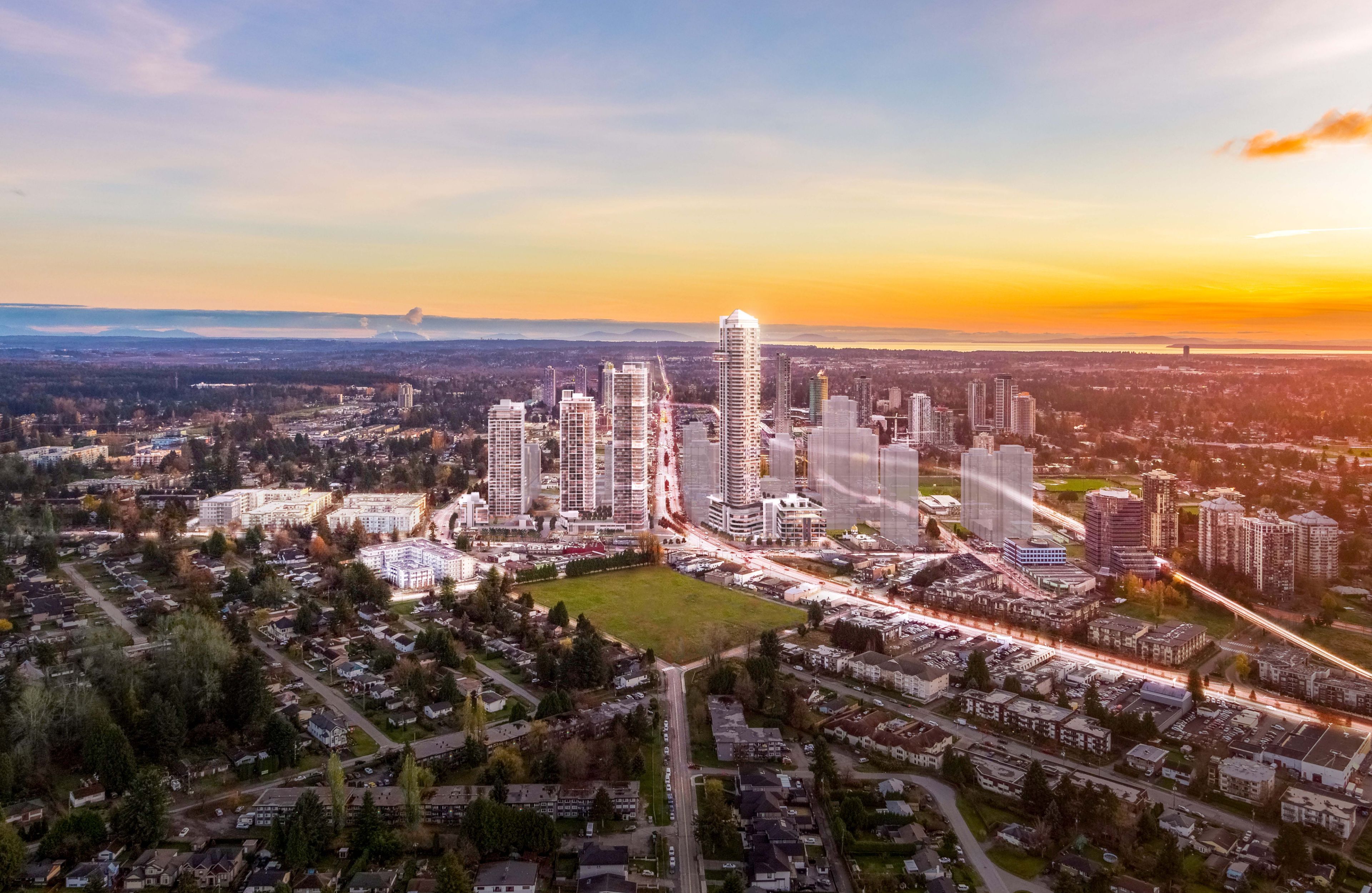
Land + Density Comparison
Land area is where the future trajectory becomes obvious:
- Surrey Land Area: 316 km². Largest land mass in Metro Vancouver. Third-largest city in BC by area, behind only Abbotsford + Prince George.
- Vancouver Land Area: 115 km². Geographically constrained by ocean + mountains + the US border on three sides.
- Surrey vs Vancouver Land Ratio: ~3x larger.
- Vancouver Density: ~5,750 people per km².
- Surrey Density: ~1,798 people per km², with substantial room to densify before matching Vancouver-level density.
The combination of more land + lower density + faster growth + younger demographics gives Surrey a structural runway Vancouver doesn't have. Even if Vancouver maintained its current growth pace (which it can't at scale, due to land constraints), Surrey would still pass it on absolute headcount.
Surrey's Fastest-Growing Pockets
2021 Census data identified the 5 fastest-growing Surrey census tracts (each gained 10%+ residents 2016-2021):
- South Surrey near Hwy 15 + 16th Ave: +5,318 residents. The single biggest absolute gain.
- South Surrey adjacent neighbourhood: +2,782 residents.
- Whalley / City Centre east of King George: +2,894 residents (bordered by 96th Ave + King George Boulevard).
- Across King George Boulevard: +2,000 residents.
- Mid-Surrey near King George + 64th Ave: +2,074 residents.
The pattern: City Centre densification along King George Boulevard + South Surrey expansion are the two strongest growth poles. Worth noting that a common misconception about Surrey is that it's mostly single-family detached, but the dominant property type today is townhomes, especially in these growing pockets.
Why Affordability Drives the Shift
The single biggest demand driver is the Surrey-vs-Vancouver price gap, which has held remarkably consistent across recent rate cycles:
- Detached: ~34% discount in Surrey vs Vancouver.
- Townhome: ~36% discount.
- Condo: ~34% discount.
Most parts of Surrey sit under an hour from downtown Vancouver, which makes the value proposition straightforward: more space + bigger floor plates + meaningful price discount, in exchange for a longer commute (often offset by remote + hybrid work).
Run real numbers through the Mortgage Calculator on a Vancouver vs Surrey purchase price + the gap in monthly carrying cost is what drives most actual moves.
Immigration Drives The Growth
The single largest input behind Surrey's growth is immigration absorption. Surrey is one of BC's primary settlement destinations for new immigrants, and that role is structural, not cyclical:
- Immigrant Share of Surrey: 45% of Surrey's population in 2021 were immigrants, slightly higher than Metro Vancouver's regional average of 42% (Surrey Local Immigration Partnership).
- Regional Growth Driver: 78% of Metro Vancouver's population growth between 2024 and 2028 is projected to come from immigration (BC Stats / Metro Vancouver).
- Recent Peak: the 2023-2024 annual growth rate of 4.5% was a record-high for Surrey, driven by the post-pandemic federal immigration targets.
- Policy Adjustment: federal immigration policy changes are slowing the rate slightly through 2026-2027, with regional growth expected to settle around 1% annually before stabilizing.
- Long-term Settlement: Surrey has a comprehensive settlement infrastructure (Surrey LIP, NewToBC, school district ESL programs, multilingual healthcare access). New arrivals stay, which compounds long-term growth.
The slight slowdown in growth rate (vs the 9.7% 2016-2021 number) doesn't change the trajectory, only the timing. Surrey still passes Vancouver. The crossover just lands closer to 2038 than 2030.
What This Means for Buyers + Sellers
For buyers: Surrey + adjacent Fraser Valley pockets (Langley, Maple Ridge, Abbotsford) have sustained demand pressure, not cyclical. SkyTrain corridor + UBC Surrey campus + ongoing densification all reinforce price + lifestyle gravity southward. Buying for use + the long hold in Surrey looks structurally sound through 2030+.
For sellers: if you own in Surrey + are considering selling, the buyer pool keeps widening. If you own in Vancouver + are considering downsizing, the suburbs will continue to absorb the demand from buyers priced out of Vancouver, which supports your sale price + your reinvestment options.
For investors: the City Centre + South Surrey + SkyTrain corridor pockets that drive Surrey's growth also drive its rental market. Rental demand follows population growth + immigration absorption, not interest rate cycles.
For everyone: the Vancouver-as-the-default narrative for Lower Mainland real estate is shifting. Surrey deserves to be on every shopping shortlist for the next decade, not as a fallback when Vancouver doesn't work.
Frequently Asked Questions
When will Surrey actually pass Vancouver in population?
BC Stats 2025 medium-growth scenario projects Surrey overtakes Vancouver as BC's largest city by 2038 (updated from earlier 2030 projections). Surrey hit ~726,369 by July 2025 (BC Stats), up from ~568,000 in the 2021 Census. Vancouver sits near 700,000. The slight slowdown vs earlier projections reflects federal immigration policy changes through 2026-2027, but the crossover trajectory is intact, just landing 2038 rather than 2030.
Why is Surrey growing so much faster than Vancouver?
Three drivers. First, affordability: Surrey detached homes run ~34% below Vancouver-equivalent, townhomes ~36% below, condos ~34% below. Second, land supply: Surrey is 316 km² vs Vancouver's 115 km², 3x more buildable land. Third, immigration absorption: Surrey is one of BC's primary settlement hubs for new immigrants, with the youngest population in the region + BC's largest school district.
How big is Surrey now compared to Vancouver?
Population (2025 BC Stats): Surrey ~726,369 vs Vancouver ~700,000, the gap has effectively closed. Land: Surrey 316 km² vs Vancouver 115 km². Density: Vancouver ~5,750 people per km² vs Surrey ~1,798. Growth rate (2023-2024): Surrey 4.5% (recent peak), Vancouver well below. For every resident Vancouver added 2016-2021, Surrey added 1.6.
Where in Surrey is the population actually growing?
The 5 fastest-growing 2016-2021 census tracts: 1) South Surrey near Highway 15 + 16th Avenue (+5,318), 2) South Surrey adjacent neighbourhood (+2,782), 3) Whalley/City Centre east of King George (+2,894), 4) Across King George Boulevard (+2,000), 5) Mid-Surrey near King George + 64th (+2,074). The pattern: City Centre + South Surrey are the two strongest growth poles.
What does Surrey passing Vancouver mean for real estate?
Demand pressure on Surrey + adjacent Fraser Valley pockets is sustained, not cyclical. Existing SkyTrain corridor + Surrey-Langley extension by 2029 + UBC Surrey campus + ongoing densification all reinforce price + lifestyle gravity southward. Vancouver remains the cultural + employment hub for now, but the population centre of gravity is shifting.
Are most Surrey homes still single-family detached?
No, this is one of the most-misunderstood facts about Surrey. The dominant property type today is townhomes, not detached. Surrey's housing mix has shifted meaningfully toward density over the last decade, and most new construction is townhome + condo. Detached remains a meaningful share, but Surrey has outgrown the "suburb of single-family detached" framing.
Will Surrey lose its character as it gets bigger?
Some of it, inevitably, but the city is large enough that the change concentrates in specific pockets. Surrey City Centre + the Fraser Highway SkyTrain corridor are densifying fastest. South Surrey, Cloverdale, Fraser Heights, Sunnyside, Morgan Creek all retain meaningful suburban + family-focused character. The city's 316 km² gives a lot of room for different neighbourhoods to evolve at different paces.
Is Vancouver actually shrinking?
Vancouver is still growing in absolute terms, just much more slowly. Vancouver added ~31K residents 2016-2021; Surrey added ~50K in the same window. The "shrinking" framing is misleading, the right framing is that Surrey is growing at roughly twice Vancouver's rate, on more land, with more housing capacity. Vancouver's land + zoning + supply constraints structurally limit how fast it can grow.
Considering Surrey?
Let's map your priorities to the right Surrey pocket.
Book a 15-minute call. We'll go through your priorities (commute, schools, lot size, character, budget) and figure out which Surrey pockets actually fit, plus when staying in Vancouver still makes sense. Or run the affordability math first with the Mortgage Calculator + grab the Surrey Relocation Guide.

Alex Dunbar Personal Real Estate Corporation
REAL Broker BC Ltd. | Living in the Lower Mainland
I help Fraser Valley buyers + sellers position for the population shift. Born + raised in Surrey, lived in 5+ Surrey neighbourhoods across 30+ years. Surrey, Langley, or Maple Ridge: book a 15-minute call and we'll narrow your shortlist before showings start.
Featured Guides
Population data + projections reflect 2021 Census + BC Stats updates available at the time of writing. Verify with the most recent Stats Canada release + your REALTOR before relying on these as the basis for an offer.
Categories
Recent Posts
GET MORE INFORMATION